
Home » 2010 MLB Draft (Page 7)
Category Archives: 2010 MLB Draft
2010 MLB Draft: Top 25 High School Righthanded Pitching Prospects
- Jameson Taillon
- AJ Cole
- Cam Bedrosian
- Dylan Covey
- Kaleb Cowart
- Stetson Allie
- Karsten Whitson
- AJ Vanegas
- DeAndre Smelter
- Drew Cisco
- Kevin Gausman
- Tyrell Jenkins
- Brandon Brennan
- Robbie Aviles
- Aaron Sanchez
- Robby Rowland
- Taijuan Walker
- Luke Jackson
- Eric Stevens
- John Simms
- Brandon Williams
- Tony Rizzotti
- Adam Duke
- Cody Buckel
- Evan Hudson
2010 MLB Draft Prospect: Jameson Taillon
RHP Jameson Taillon (The Woodlands HS, Texas)
- heavy 92-94 FB; also seen at easy 93-95; most recently hit 96-97
- plus 77-84 CB; 75-76 maybe?
- underutilized 76 CU with real potential
- 83-84 with SF
- plus command
- 6-7, 230 pounds
- popular comps include Gerrit Cole, Stephen Strasburg, Josh Beckett, and, wait for it, Roger Clemens…
[Before I get to all of the drawn out prose I had originally planned, let me add this late edit that doesn’t really fit in with the rest of the piece, but was too good to let pass. Random Anonymous Scout (so take it for what it’s worth) told me the other day that Jameson Taillon could currently pitch out of a big league bullpen and hold his own. Pretty high praise, I thought. It also reinforces the idea in my head that Taillon is the 2010 version of Tanner Scheppers, another talented fastball/power curve guy that I thought could pitch out of the bullpen from day one if called upon. For the record, I don’t advocate either guy pitching exclusively out of the bullpen professionally, although I get why it makes sense for Scheppers to go that route. Anyway, back to your regularly scheduled Taillon scouting profile…]
The first sentence in my entirely hypothetical yet undoubtedly terrible essay entitled “Why I Love Following Pro Sport Draft(s)” might go a little something like this: “There’s a very obvious thrill that comes in forever chasing the next big thing…” One of my favorite parts of following the respective drafts in all of the major sports is the lack of and/or conflicting information out there about certain players. This isn’t so much a problem with NBA and NFL draft coverage where the college game is televised seemingly every day of the calendar year, and I can never personally name more than 3 players in a given NHL Draft, but the Rule 4 MLB Draft is different. Sure, baseball’s draft coverage has become more prevalent what with the rise of many quality rogue handsome bloggers — which reminds me that I have to update the sidebar links in the coming days — in conjunction with increased output from the major media standbys (BA/Kevin Goldstein/Keith Law), but information regarding the skills of specific draft prospects, high school guys mostly, can be very, very hard to find, especially outside of the top handful of big name prospects. I like that. I like the mystery that comes with nobody having a 100% idea of the ins and outs of a player’s particular skill set.
(Incidentally, one of my ideas for “proving” the NBA and NFL Drafts get more coverage than the MLB counterpart was by comparing Google hits for each phrase. I figured “NFL Draft” would have the most by far, “NBA Draft” would be a clear second, and either “MLB Draft” or “NHL Draft” would bring up the rear. How wrong I was. “MLB Draft” produced more hits than any of the others. Go figure.)
The lack of concrete information regarding specific players makes following the baseball draft all the more rewarding in the end. You can really come up with just about any wacky justification about why you prefer Player X over Player Y as long as you can back it up with some kind of reasoned argument. It’s damn hard to say with any kind of certainty that any one player is definitely, absolutely, positively a better prospect than another; there are too many variables at play. Prefer Player X? Fine, but tell me why. Hope your team drafts Player Y? Alright by me, so long as you can explain the relative pros and cons of the two.
There normally is more exposure given to college athletes and certainly more of a significant statistical base to draw from, so arguments over which college players make the best pro prospects have more of a “right/wrong” feel to them. Arguments about prep players, however, can be spun in any number of directions. With limited and/or conflicting information to go off of, it’s inevitable that personal preferences will come into play. If you are predisposed to believing the changeup is the neatest pitch around, then chances are high you are going to elevate the ranking of a pitcher with a plus change. I watched a college game a few years ago next to a scout that told me that his scouting director was only interested in college pitchers with at least two above-average to plus pitches. Another scout chimed in that his scouting director told him that any prep pitchers taken by his time were required to at least show three different pitches, no matter the quality. We all look for different ways to differentiate the good prospects from the so-so prospects, and, perhaps more importantly, the great prospects from the good prospects.
There are a lot of different ways one can evaluate high school pitching prospects, with no real right way or wrong way of reaching a conclusion. Of course, let’s be honest here – there is little accountability on my end when it comes to how I rank these guys. I take pride in my work and am ridiculously appreciative of every single reader who stops by, but I understand my job isn’t on the line when I endorse one player over another. One of the things that really stood out to me in really digging deep into the high school pitching prospect ranks last year was how rare finding a high school pitching prospect with two present plus pitches is. Jameson Taillon has those two pitches.
Taillon will easily sit in the low-90s as a professional, with a peak fastball that has already reached the high-90s. He is close to a finished product coming out of high school as I can remember in recent years, a fact that will unbelievably work against him as draft day draws closer. The comparisons to fellow top high school righthander AJ Cole are inevitable. AJ Cole has a plus fastball and a potential plus curve; Jameson Taillon has a plus fastball and a present plus curve. Taillon also has the current leg up with his changeup, although he hasn’t really shown the pitch off in real game situations just yet.
It’ll be really interesting to see if the Cole vs Taillon storyline emerges as a viable draft subplot this spring. The two young arms are a study in contrast, despite sporting similar high end velocities and offspeed stuff. Additionally, both young righties have top of the rotation upside. Cole may ultimately have more upside, but there is little arguing he is currently further from reaching it. Taillon is the more finished product, but some scouts worry he is currently throwing better than he’ll ever throw professionally. In a world that encourages controversy by demanding that all things boil down to building up one side of an argument while simultaneously tearing down the other, it would not be the least bit surprising to see plenty of people frame the Cole vs Taillon debate in this way. There is no problem with picking a favorite horse in the race, heck it’s part of the whole reason this site is around. Building up one player is appreciated, but I don’t see why it has to come at the expense of another. I guess it’s just the subtle different between Cole over Taillon (or vice versa) and Cole vs Taillon; I’m hoping for the former, but I fear we’ll see more of the latter.
I can’t really speak to the rather generous comps to Strasburg, Beckett, and Clemens, but I think it’s pretty clear that Taillon is a far more well-rounded prospect than Gerrit Cole was coming out of high school in 2008. To take it a step further, Taillon’s scouting profile reminds me a little bit of what scouts said about Josh Johnson as he was coming up through Florida’s system. While I’m not brave enough to claim Taillon will ever have a pro season quite like the one Johnson just had, I have no problem pointing out that Taillon is currently a better prospect than Johnson ever was. Taillon has a better overall fastball, better secondary offering (though Johnson’s slider has turned into a real weapon professionally), and eerily similar command, makeup, and mound presence. The light clearly went on for Johnson enough to turn him from a good prospect to a great pitcher, a perfect example of how different developmental paths can be for different players. There’s no telling what kind of path Taillon will actually take, but the fact that he even has the chance to follow in the footsteps of a guy like Johnson is darn exciting.
A thought just occurred to me. I may be a bit overzealous with some of my comps, but let’s go with what I’ve got so far, for argument’s sake if nothing else. If AJ Cole is Justin Verlander and Jameson Taillon is Josh Johnson, and neither player is excepted to go number one overall in this draft, then what is there really left to say about what kind of prospect Bryce Harper is?
2010 MLB Draft Prospect: AJ Cole
RHP AJ Cole (Oviedo HS, Florida)
- 91-93 FB/94-96 peak; has reportedly been as high as 98
- potential plus 76-80 KCB
- average 84-88 SF that acts as a change
- 78-81 SL that appears to come and go from outing to outing (?)
- projectable frame at 6-5, 190 pounds
- Zach Wheeler and Rick Porcello comps

Lots to like about AJ Cole’s game, clearly. His biggest strengths include his present plus fastball velocity, a potential plus knuckle curveball, and that wildly projectable 6-5, 190 pound frame. For a prep pitching prospect, that’s about as close to the holy trinity as you can get. I’m just about positive that I’ve seen Cole throw a splitter and I can’t remember ever seeing him throw a true change, so I’m doing a bit of guesswork when I claim he uses that mid-80s split as a de facto changeup. Without any legit industry source backing me up, I’ll hedge my bets and stick with calling the pitch a “splitter that he uses as a facsimile for a change” for now. Whatever you want to call the pitch, it’s probably a stretch to call it anything more than average right now. That may sound like a knock, but remember how rare it is to see a high school prospect with three present average or better pitches. An average third pitch may not be a negative, but it does highlight a clear area where Cole could stand to improve this spring. There are currently conflicting reports on the existence of Cole’s slider (I personally haven’t seen it), but smarter men than I have clocked it anywhere from 78-81 miles per hour. The similar velocities of the slider and his knuckle curve has me wondering if Cole actually throws two distinct breaking balls at all. If I had to guess, I’d say his actual repertoire consists of a fastball, a spike curve sharp enough that it’s been confused with a slider, and a changeup with above-average downward movement that may or may not be held with an actual splitter grip. A rough conservative breakdown of that arsenal might look something like this:
Fastball: 60/70
Curveball: 45/60
Changeup: 40/55
I see a lot to like in the Cole’s delivery and throwing mechanics. His arm action seems nice and easy and he appears to have little trouble repeating the same consistent 3/4 delivery from pitch to pitch, batter to batter. The one negative thing I can say about Cole’s mechanics is that he seems to rush through each step of his delivery a heck of a lot quicker than most guys I’ve seen. That last problem seems like one that can be corrected with good professional coaching, but that’s an evaluation that will be made on a team-by-team basis this spring.
Speaking of pitching mechanics, allow me to make an admission of apathy on the subject. It’s true, I’m largely indifferent to pitching mechanics. My pet theory is that 99.99% of the baseball watching population can only derive so much usefulness from evaluating a pitcher’s throwing mechanics. In my estimation, all pitching deliveries fall somewhere along a bell curve that looks a little bit like the following – maybe 15% of the time a pitcher’s mechanics are so perfect (Nolan Ryan, for example) that it is abundantly clear whatever he is doing is working and will continue to work going forward, roughly 15% of the time a guy’s mechanics are so obviously cringe-worthy that you can’t help classify his arm as nothing more than a ticking time bomb, and then there is that big fat middle 60% or so that falls somewhere in between the two extremes. If a pitcher has mechanics in that middle part of the curve, I’m willing to change my personal focus from analyzing each individual part of the setup, windup, and follow through (yeah, like I can really do that anyway…) to worrying about a) does the pitcher have any kind of track record of arm problems, b) can the pitcher repeat whatever they are doing on the mound pitch after pitch after pitch, c) does the pitcher maintain velocity of his fastball and sharpness of his breaking balls, and d) does the pitcher tip off the batter by showing clear differences in arm speed when throwing different pitches. Those four things are what I care about most. That is, of course, unless something obviously good or bad (highly subjective, I know) jumps out at me. If enough people I talk to/read like a certain guy’s mechanics, I’m sold. If, in addition to getting a passing mark from somebody I trust, the pitcher is able to repeat his delivery and maintain a consistent velocity while doing so, I’m sold twice over.
The popular industry comp of Porcello works in a lot of ways, but I much prefer sizing the young Florida righthander up with Porcello’s Detroit teammate, Justin Verlander. Verlander represents Cole’s ultimate upside as a big leaguer, but it’s interesting to compare the two pitchers at similar points in their development. Despite possessing a 93 MPH peak velocity fastball, Verlander wasn’t even drafted coming out of Goochland HS (VA). Scouts questioned his shaky control and inconsistent mechanics while also citing concerns over how his 6-4, 170 pound high school frame would hold up as a professional. He embarked on an intense workout program upon enrolling at Old Dominion that helped move him closer to the finished product that we see today. Cole offers a similar velocity floor (low-90s) when compared to the high school version of Verlander, but has the edge when it comes to prep peak velocity as he has been clocked as high as 96-98 MPH at various stages in the past year. So, Cole has a better fastball at this point in his development, plus more consistent breaking stuff and a more advanced overall feel for pitching. If, and it is admittedly a pretty sizable if, Cole’s 6-5, 190 pound frame fills out like Verlander’s similarly projectable high school frame did, then you could eventually be talking about two very similar pitching prospects come draft time. With a little more muscle packed on, Cole’s fastball has the potential to be one of the signature pitches in all of baseball much in the same way Verlander’s heater has emerged as a special offering.
If you don’t like the Verlander comp, or the more popular Wheeler/Porcello industry comps, maybe you like the totally coincidental comparison to a trio of Yankee stars, future, present, and past – Phil Hughes, AJ Burnett, and a bigger and harder throwing version of Mike Mussina. When the upside is Burnett (3 WAR floor), Mussina (future HOFer), and Verlander (2.80 FIP in 2009), and the most similar prospects in reason memory are Rick Porcello ($3.5 million bonus) and Phil Hughes (BA’s fourth best prospect in baseball in 2007), only signability concerns or injury will keep you out of the first ten picks.
Where The College Talent Is
I’m not well informed enough to make a controversial stance and say that the following universities have the “best” rosters (with regard to potential pro talent, not necessarily winning college talent), so I’ll totally wimp out and, for now anyway, call these rosters some of the most intriguing that I’ve seen so far. I’ve stuck to the big name conferences, but I’ll expand this list to some of the little guys as the offseason rolls along.
ACC – Virginia
Big East – South Florida
SEC – LSU/Georgia/Vanderbilt (even when being spineless, I can’t pick a favorite…)
Big 12 – Texas
Pac-10 – Oregon State
Big West – UC Riverside
West Coast – Gonzaga
Conference USA – Rice
Mountain West – Texas Christian
Random College Plus-Plus Tools
So, I’ve got a 33-page Word document going with every notable college team listed (including junior colleges and D-II/D-III teams) that is now up over 11,000 words. I don’t say it to brag — I mean, come on, how big a dork would I have to be proud of something like that? — but rather to set up the next couple of days of posting. Since my current Word doc has real quick notes on a ton of college players, I thought it would be a good idea to share out some of the more interesting findings so far. I won’t have complete player profiles done on the major guys for a while, and I doubt I’ll ever have complete profiles written on some of the lesser names, so this gives me a chance to shine the spotlight on some lesser known guys who happen to feature a truly standout tool or two.
Rutgers
SR C Jayson Hernandez (2010) and his jaw-dropping throwing arm. The guy may have little to no power to speak of, and he may be considered one of the weaker hitters currently playing major college ball, but, man oh man, can this guy throw. If he can wake up the bat even a teeny, tiny bit, he could find himself drafted with the chance of someday being a shutdown all-defense big league backup.
South Florida
JR C Eric Sim (2010) and his almost as good as Hernandez’s plus-plus but not quite all the way there yet arm. Overall, Hernandez is the better defender; he is closer to a finished product defensively (his ability to block balls and his footwork are both currently ahead) and, as mentioned, has a slightly more impressive arm. Sim’s bat is more of a question mark at this point. I’ll be honest and say I’m not really sure how it’ll play in the Big East this spring. What I do know is that some scouts have already given up on Sim as a catcher and are instead dreaming of what kind of heat his arm could generate when getting reps throwing off the mound.
Texas A&M
SO RHP/SS Adam Smith (2011) and the bazooka launcher attached to the right side of his body. If you’ve been following the draft over the past few years the name Adam Smith should sound familiar. No, not the Wealth of Nations guy. The highly sought after 2008 recruit who wound up in College Station playing for the Aggies. Smith has always had a crazy strong arm, but only recently has he had the chance to showcase it regularly on the mound. I still believe he can play a capable SS/3B and hit enough to be productive at either spot, but I couldn’t fault a team that instead saw him as a potential closer-type throwing easy 97 mph fastballs off the bump.
San Diego
FR OF Matt Moynihan (2012) doing his very best Usain Bolt impression with legit plus-plus speed. A future piece here is definitely going to be about players who fit the ideal “leadoff man profile.” I must have wrote that phrase about 50 times when during the quick reports of college guys this year. Maybe I’m misremembering previous year’s talent bases, but it seems that 2010-2012 has a disproportionate amount of players with the potential for really good big league careers as lineup table setters and up the middle plus defenders. Moynihan has that potential, though he is obviously a few years off from getting there. He combines that plus-plus speed with good discipline along with superior range and an arm that fits well in CF to make himself an enticing prospect to watch.
Old Dominion
JR LHP Kyle Hald (2010) and his dominating split-fingered changeup. Hald doesn’t throw hard (sitting mid-80s), but he does everything else you could possibly want a pitcher to do well. The secondary stuff is solid (hard SL and decent show-me CB), he is an outstanding fielder, his pickoff move is a legit weapon, and his mechanics are clean, consistent, and repeatable. That alone would make him a potential mid-round get, even when factoring in the below-average fastball. It’s the inclusion of his unique split-fingered change that makes him a sleeper to watch in 2010. I may be wildly overrating him based on one great pitch, but it’s a pitch that impressed me so much I’m willing to stick my neck out for it.
Jacksonville State
SR RHP Alex Jones (2010) and his surgically repaired elbow’s nasty slider. Jones is coming off from Tommy John surgery and, unfortunately, is feeling the impact hard. His fastball that once topped out in the low-90s was only able to get up over 86 this past summer. Thankfully the procedure and subsequent time off had no negative consequences on his plus-plus slider, a pitch that may be the best of its kind in all of college baseball. If Jones can pick up some of that lost velocity, he’ll find himself as another potential mid-round college reliever sleeper. He’s got the pro body (6-6, 190 pounds) and financial advantage (he’d be a senior sign) that many similarly talented pitchers in the mid-rounds seem to lack.
Quick College Look Ahead – UConn, LSU, and Kansas
Not sure what direction to take now that I’m finally staring at almost four months without “meaningful” baseball. Right now the plan is to go back and respond to any comments I’ve missed over the past few weeks, continue plugging away with college/high school draft scouting reports, and sharing out any interesting tidbits that I happen to run across – probably doing that last bit on a Monday/Wednesday/Friday schedule. I’m open to providing just about any kind of content (college team profiles, closer look at high school player groups, top ten positional rankings, whatever), so if there is anything in particular that anybody wants to see, drop me a comment or an email. It’s a loooooooooong offseason and this normally a pretty dead period for any kind of draft news, but reading and writing about faraway prospects may help the next couple of frigid months go a little quicker. For now, here are a couple notes about some interesting college teams and players to watch heading into 2010.
Connecticut
The Huskies feature one of the nation’s most intriguing pair of two-way talents in SO RHP/SS Nick Ahmed (2011) and SO RHP/3B Kevin Vance (2011). Ahmed turned some serious heads in summer league play with a fastball sitting in the low-90s, a low-70s curve with promise, and a presently league average change. Ahmed may have been the hotter name over the summer, but Vance’s stuff is currently a touch better. He has similar velocity to Ahmed (normally sitting 90-92 with the FB), but a better overall breaking ball and plus command give him the overall edge. Both players figure to see plenty of time on the mound in 2010, though neither should be limited to just pitching. Ahmed and Vance will each fight for time on the left side of the infield, an area that Connecticut has well covered between the two two-way guys and returning star Mike Olt. If Ahmed locks down either the 3B or SS spot on a semi-regular basis (with Olt manning the other spot), don’t be surprised to see Vance get a shot working behind the plate.
LSU
The defending champs bring back an absolutely loaded squad. There are some questions on the pitching side that will need to be sorted out, but the Tigers outfield depth is just silly. SO OF Mike Mahtook (2011), JR OF Leon Landry (2010), and SO Johnny Dishon (2011) would have been my guesses as the starting outfielders heading into the spring, but the return of SR OF Blake Dean (2010) and the arrival of SO OF Trey Watkins (2011) give LSU five legit pro prospects in the outfield. Mahtook is a definite five-tool talent who just looks like a future first rounder, Landry will draw plenty of Jared Mitchell comps due to his football playing background and impressive raw physical tools, and Dishon profiles similarly to Mahtook but may be just a little bit short in each tool category when directly compared to his outfield mate. Dean is slowly rounding back into baseball shape after a run of bad luck offseason medical work. Meanwhile, all early buzz on Trey Watkins has been nothing but positive. Reports of his plus-plus speed have not been exaggerated as Watkins really is a joy to watch run, especially when he is doing the running after having driven a ball into the gap for a triple.
Kansas
The folks in Lawrence figure to be pretty occupied by a different kind of bball through early April, but the left side of the Jayhawks infield deserves an early mention before getting buried in the avalanche that is KU basketball. JR 3B Tony Thompson (2010) has special potential with the bat and a cannon for an arm at third. His 6-5, 220 pound frame, power potential, and questionable future at third base (even with the big arm he may have to slide across the diamond as a pro) garner late career Troy Glaus comps. The man to his left will be JR SS Brandon Macias (2010), another Kansas infielder with plus arm strength. Macias has very good defensive tools that should play up with as he gains experience playing at the highest level of collegiate ball. He has enough pop in his bat to go along with above-average speed to make him an interesting five-tool player to watch this spring.
Top 50 2010 MLB Draft Prospects – Expanded Version
C Bryce Harper
The Harper backlash has already begun in some corners of the internet, but I’m going to be oh so bold and stick with him as the top draft prospect heading into 2010. Keep in mind this is coming from the same guy who totally called Stephen Strasburg as the top pick last year. Amazing prediction, am I right? Now you see why I have to disappear for months at a time during the draft offseason – I’m working hard coming up with such bold, innovative predictions that allow me to stand out amongst the crowd of all the other amateur draft prognosticators. I should really start charging for my brilliant insight…
RHP Jameson Taillon
3B Nick Castellanos
RHP AJ Cole
OF Austin Wilson
Picking Harper for the top spot was a piece of cake. Picking Taillon right behind him is almost as easy. A piece of pie, if you will. Taillon’s extensive arsenal of quality pitches (heavy FB, nasty low-80s SL, near-plus high-70s CB, occasional splitters and CUs) and high level of high school competition put him above the rest of this year’s impressive crop of teenage righthanded pitching. After last year’s lackluster prep position player class, I’m admittedly a little bit desperate for some exciting high school bats to emerge this spring. To that end, I throw my full support behind both Castellanos and Wilson as legit high first round caliber talents. By the way, I hate pie. I don’t mean I hate Taillon – I’m through with that lame metaphor. I mean actual pie. Apple is alright, I guess. Lemon meringue is probably my favorite. The rest? No, thank you. Makes Thanksgiving dessert a bit of a downer for me, but, on the bright side, it allows me more freedom to eat as much of the dinner portion of the meal as I can possibly stuff down my throat.
RHP Anthony Ranaudo
RHP Karsten Whitson
LHP Drew Pomeranz
RHP Brandon Workman
RHP Stetson Allie
Ranaudo is lower here than even I expected, but the upside of the five names in front of him partially explains his low standing. I also have personal reservations about big guys that don’t throw nearly as hard as expected. There is plenty of tape on him floating around, so I’ll need to take a closer look and break him down in the near future. Workman has been a fascination of mine since the Phillies failed to sign him coming out of high school, so I feel confident in his placement based on his outstanding raw stuff and physical build. Allie is ahead of Whitson on talent alone at this point, but the up and down results that Allie puts up make him a very difficult player to accurately access.
INF/OF/RHP Yordy Cabrera
RHP Deck McGuire
3B Zack Cox
Something about those draft eligible sophomores always intrigues me. I haven’t talked to many people who think Cabrera will stick at shortstop professionally, but he’s so darn talented across the board that I’d be willing to gamble on him being productive wherever he winds up on the diamond.
RHP Jesse Hahn
LHP Chris Sale
The two big names from the Cape are still a mystery to me as far as their prospect standing goes. They are both very good prospects, of course, but the question of how good remains to be answered. Yes, I realize I could write that exact same blurb about every player on this list, especially the college guys. I may have worked too hard to cover up my high school blindspots. Time to get back to studying the college game for a bit, starting with the high upside, high flameout possibilities listed above.
RHP Cameron Bedrosian
RHP Kyle Blair
RHP Matt Harvey
Undersized righthander with a hot fastball and an excellent curve with big league bloodlines? If it hasn’t been made before, I’m happy to be the first to throw out the Kyle Drabek/Cameron Bedrosian comparison. Blair and Harvey have seen their respective stocks drop a ton in the past calendar year. I’m a believer in the rule that once you show a skill, you own that skill. Neither Blair nor Harvey has been seriously injured. Neither Blair nor Harvey has forgotten how to throw a baseball with nasty stuff.
RHP Dylan Covey
RHP Kaleb Cowart
MIF Anthony Wolters
C/OF Stefan Sabol
OF Bryce Brentz
LHP James Paxton
Wolters and Sabol could both be impact players at up the middle defensive positions as professionals, with Wolters having a chance to be a truly special defender at second base in time. Brentz and Paxton might have cases as having the highest upsides of any position player and pitcher in the collegiate ranks, respectively.
RHP Zach Lee
RHP Peter Tago
RHP Jesus Valdez
RHP AJ Vanegas
RHP Justin Grimm
OF Angelo Gumbs
OF Brian Ragira
C Rob Brantly
Valdez doesn’t have quite the velocity of some pitchers in his class, but the movement he gets on his fastball makes it a legit plus pitch going forward. Vanegas may be a quick riser as a professional; prep pitchers that can throw four pitches for consistent strikes tend to move fast. I think I have Ragira too low in this spot. He is a legit CF prospect with an above-average big league quality arm, in addition to a mature beyond his years approach at the plate. Brantly is another draft-eligible sophomore with tremendous upside; in a pretty good year for college catching, he’s the top four-year college backstop on my board.
OF Levon Washington
SS Rick Hague
SS Christian Colon
Let’s talk Christian Colon for a minute, shall we? I guess my lack of love for his game comes from me severely underrating the value of a league average big league shortstop (a rookie mistake on my part, I admit) and also being less than impressed when seemingly every scouting report about Colon begins and ends with talk about his personality, leadership, and the way he makes the most of his average at best tools. No doubt Colon’s makeup is totally off the charts and his defensive chops make him a slam dunk to stick at short professionally, but I tend to focus more on the “average at best tools” part of that discussion than the “personality” and “leadership.” I’m both ready and willing to convinced I’m totally wrong on Colon, but that’s where things stand now. For what it’s worth, I’ve only seen Colon play once since watching him in person in high school, so maybe I’m judging him unfairly based on my limited and outdated memory of his skills. Also, for what it’s worth, I have a scouting buddy who has seen Colon play a ton from his junior year of high school until this past summer and he absolutely loves everything about Colon’s game.
RHP Kevin Gausman
RHP DeAndre Smelter
RHP Tyrell Jenkins
OF Leon Landry
3B Victor Sanchez
Keyvius Sampson was my guy from day one last year. This year’s version might be Tyrell Jenkins. Jenkins has a lot of nice things going for him on paper – good velocity, sharp breaking ball (slider), very athletic, and a great amount of projection going forward. Sanchez seems like he is getting lost in the shuffle as another formerly highly touted high school prospect who has battled injuries and inconsistency at the college level. Since I love making unfounding comparisons, let’s call Sanchez the hitting equivalent of the previously mentioned Matt Harvey and Kyle Blair combo platter. Landry is a total upside play here, but I trust the LSU coaching staff like few others.
1B Christian Yelich
SS Sean O’Brien
1B/3B Kris Bryant
RHP Aaron Sanchez
RHP Nick Tepesch
INF Zach Alvord
If I had to pick one guy on my list to drop off over the course of the season, I’d probably go with Yelich. That naturally begs the question of why he is on the list in the first place. Yelich is like the hitting version of Stetson Allie, an up and down prospect that can look like a late first rounder one day and a fifth round lottery ticket on the next. It gets repeated every year, but it’s important: prep players limited to first base need to be able to hit, hit, and hit some more to be taken seriously as a draft prospect. I realize I have O’Brien lower than Colon on this list, but I’m not quite sure why. I’m a man who loves upside, and O’Brien’s ceiling is higher than just about any other shortstop in this year’s class. Of course, I’m also a realistic enough fellow who can readily admit that Colon is a much more certain bet to reach his upside than O’Brien. In one of the most spot-on comps of the year, scouts have compared Kris Bryant to a young Troy Glaus on more than one occasion. It’s only been 24 hours since I posted this list, but I think I’m already ready to knock Alvord off…
RHP Robbie Aviles
C Micah Gibbs
SS/RHP Justin O’Conner
LHP Jessie Biddle
I think Justin O’Conner could wind up as this year’s Casey Kelly, a ridiculously talented two-way player picked late in the first round by a team willing to pony up the big bucks for his services. In the end, however, I think O’Conner will deviate from the Kelly plan by proving himself to be a better hitter than pitcher. Biddle is the token prep lefthanded pitcher on the list. I felt bad about not including any young lefties on the 2010 list after the totally stacked 2009 class, so I threw lefties everywhere a bone with Biddle’s inclusion.
Big Board 1.0: Top 50 2010 MLB Draft Prospects
- C Bryce Harper
- RHP Jameson Taillon
- 3B Nick Castellanos
- RHP AJ Cole
- OF Austin Wilson
- RHP Anthony Ranaudo
- RHP Karsten Whitson
- LHP Drew Pomeranz
- RHP Brandon Workman
- RHP Stetson Allie
- INF/OF/RHP Yordy Cabrera
- RHP Deck McGuire
- 3B Zack Cox
- RHP Jesse Hahn
- LHP Chris Hale
- RHP Cameron Bedrosian
- RHP Kyle Blair
- RHP Matt Harvey
- RHP Dylan Covey
- RHP Kaleb Cowart
- MIF Anthony Wolters
- C/OF Stefan Sabol
- OF Bryce Brentz
- LHP James Paxton
- RHP Zach Lee
- RHP Peter Tago
- RHP Jesus Valdez
- RHP AJ Vanegas
- RHP Justin Grimm
- OF Angelo Gumbs
- OF Brian Ragira
- C Rob Brantly
- OF Levon Washington
- SS Rick Hague
- SS Christian Colon
- RHP Kevin Gausman
- RHP DeAndre Smelter
- RHP Tyrell Jenkins
- OF Leon Landry
- 3B Victor Sanchez
- 1B Christian Yelich
- SS Sean O’Brien
- 1B/3B Kris Bryant
- RHP Aaron Sanchez
- RHP Nick Tepesch
- INF Zach Alvord
- RHP Robbie Aviles
- C Micah Gibbs
- SS/RHP Justin O’Conner
- LHP Jessie Biddle
Signing Thread Updated
Finally got around to updating the signings thread, check it out via the link at the top if so inclined. Because I feel bad about the general lameness of this post (hey, I updated something! = lame), here’s a comment that serves as a quick teaser to some of the 2010 stuff on the way. We’re talking 2010 prep arms here:
Cole and Taillon are 1-2, no doubt, but Whitson, Allie, and Covey are all getting potential first round buzz. I personally loved what I saw on video of Cam Bedrosian. Another big personal favorite of mine is Jesus Valdez, super projectable and already armed with a fastball with sick late life.
I’m also the guy that was telling anybody that would listen (my mom) that Mike Burgess would go higher than Jason Heyward at around this point in the process, so my track record of early projections hasn’t been so great. Hey, I try…
Ha, I actually found my original quote re: Burgess vs Heyward. The internet is a magical place…
As for the question at hand, I personally like Burgess best at this point. The combination of raw power, explosive (though inconsistent) swing mechanics, 94 mph arm strength, playable speed (6.9 60), and baserunning instincts well beyond his years make for a heck of a total package. Heyward and Vitters are both excellent prospects in their own right and any argument supporting either would definitely have merit.
Speaking of Vitters, I’ve really been impressed with him and the group of high school third basemen in general this season. My favorite of that group and minor sleeper come draft day is Victor Sanchez from California. I don’t think I’ll be able to go see any of the top HS third basemen this year in person, but I’d be very interested to see how they stack up against last year’s consensus top high school infielder, Billy Rowell (a player who I was lucky enough to see in person multiple times).
I feel like that quote encapsulates so much of what I’m all about when it comes to the draft. Poor projections (Burgess over Heyward), being too quick to look too far into the future (talking about Sanchez, a prime 2010 draft, back in 2007), and bragging about getting to see a player in person (yes, because seeing Rowell a bunch in high school makes me an expert!). I hope I’ve grown a bit since then, but…I doubt I have. Eh, personal growth is so overrated.
Bryce Harper
That draft in 2009? Old news. Stephen Strasburg? Forget about him. We have seen the suddenly surprisingly near future – all Bryce Harper, all the time.
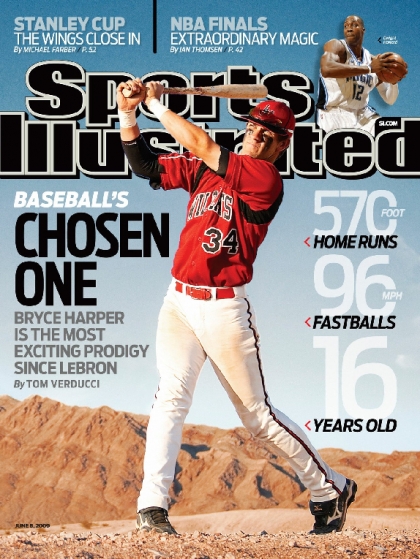
Photo Credit: Sports Illustrated
I’m not a fan of writing about straight “news” pieces (there are literally thousands of better websites to go to for that), but I’ve publicly ignored Bryce Harper long enough. The big story that broke over the weekend is that, yes, Nevada high school catcher Bryce Harper has taken the first steps towards locking up his place atop 2010 draft boards everywhere by registering for classes at the College of Southern Nevada. Harper has stated his desire to begin courses at CSN in August, earn his GED in the fall, play for the CSN baseball squad in the spring of 2010, and then, assuming everything goes according to plan, get picked number one overall by the Washington Nationals (thus earning more money in his signing bonus than my overpriced college educated behind will make in a lifetime, by the way) next June. Consider that last bit a sneak preview at the upcoming first edition of the 2010 mock…
One little thing from all the articles re: Harper that have broke over the past few days has left me a bit confused. I’m not quite sure how he plans to attend junior college classes beginning in August before trying to get his GED sometime in the fall. That’s the timeline presented in everything I’ve read about Harper’s story, but it doesn’t seem to add up. What am I missing here? Can you really attend junior college classes before getting a high school diploma (or equivalency)?
[UPDATE – After deciding to be proactive for once, I did about two minutes of Googling in an attempt to answer my own questions. It appears that in many states you can enroll at junior colleges (or in some cases four-year colleges) without first obtaining a high school degree. Interesting. It’s true what they say, you really do learn something new every day.]
Photo Credit: Palm Goon
Pitch Counts
No, this won’t be another rant about the responsibility (or lack thereof) that college coaches have towards balancing saving their own hides by pleasing the alumni base by winning as many ballgames as possible in the short-term with respecting the overall health and potential loss of future professional earnings of student-athletes supposedly under their care. (Man, how’s that for a run-on sentence? My high school English teacher must be rolling in her grave…). Nor will it be a treatise on how often evidence showing high pitch counts (especially pitch counts over 120) as dangerous to a pitcher’s long-term health and short-term performance is ignored by a certain segment of the population, a group that still believes in the infallibility of many of the arm shredding techniques of yesteryear. (Not only a run-on sentence, but also awkwardly worded…I’m on a roll!). No, none of that – not today, anyway.
All I’m trying to say is that high pitch counts absolutely have to be considered when teams stack their draft boards each year. Nothing more, nothing less. To that end, let’s take a quick look after the jump at a few of the big names stretched beyond a “safe” number of pitches this past weekend…
What A Jackass
I really, really, really hope this doesn’t become a recurring feature here, but I’m just about positive that it will be. It’s time to look back through the archives and have a good laugh at something stupid stuff I’ve said. The only hard part is narrowing down which dumb thing to choose…
This particular rambling thought was from March 1, 2009. It’s not necessarily the dumbest thing ever put in print (notice my wonderful use of qualifiers and hypotheticals), but it’s certainly looks silly in hindsight. Behold my genius after the jump…
Strasburg’s Latest – March 27th, 2009
Strasburg’s latest start against TCU went pretty well:
- 8 IP 3 H 2 ER 1 BB 14 K (5 GO/5 AO)
- Carpenter, Curry, and Vern went a combined 0-8 (BB, 4 K) against him
Not to pat myself on the back too hard, but I think it’s fair to say the predictions from yesterday held up pretty well, no?
- Strasburg’s final line prediction: 7 IP 4 H 1 ER 1 BB 14 K
- Carpenter, Curry, and Vern: 2-8, 2B, BB, 5 K
Off the grid for the weekend ahead, but expect an in-depth look at the nation’s finest catching prospects starting Monday…
Strasburg Day
Stephen Strasburg takes the hill tonight against nationally ranked TCU. Here’s what he’s up against:
- Matt Curry (’09) – relatively slow start shouldn’t obscure the fact that the junior college transfer has a big lefty bat that will play; compared to current Phillie Matt Stairs (aka Jon Broxton kryptonite)
- Matt Carpenter (’09) – better college player than prospect, but can’t argue with his production so far (.371/.525/.600 with a 23/11 walk to strikeout ratio); if he can stick at third in the long-term, could get a look as a mid-round senior sign
- Matt Vern (’09) – another player who profiles better as a very good college bat rather than a legit pro prospect, but still capable of hitting the ball a long way when he gets a piece (team leading 6 HRs); Vern’s defensive limitations could keep him from being drafted altogether, but he’s no less of a threat to take Strasburg deep because of it
TCU has a senior-heavy lineup, but no singular hitter that can realistically be expected to do much damage against San Diego State’s ace. My totally baseless prediction for Strasburg’s final line:
7 IP 4 H 1 ER 1 BB 14 K
In addition, I’ll predict a cumulative 2-8 night (including a double, a walk, and five strikeouts) for the three players named Matt listed above.
I’m most curious to see how Curry does against Strasburg. One game is too small a sample to base anything important on, but, as a lefty bat with a powerful, all-or-nothing style swing, he actually matches up pretty well. Curry’s future as a pro could be as a pinch-hitter capable of hitting the ball out every time up, so his at bats against Strasburg correlate pretty well with the kinds of matchups he may see coming off the bench to face fireballing relief aces.
Anyway, any other guesses about how Strasburg will perform on Friday night?
College Baseball Weekend Five – Pitching Retrospective Continued
So much pitching to recap, so little time…
- Relievers, relievers, and more relievers
Jake Morgan, redshirt sophomore from the University of Mississippi, gets a special mention for his complete wipeout of Alabama: (2 IP 1 H 0 ER 0 BB 6 K)
Long, lanky Matt Miller (6-6, 215) of Michigan’s great outing (3 IP 1 H 0 ER 1 BB 5 K) pushed his K/IP total to 16/12.2 on the season. It’ll interesting to see if he is in the mix for a starting spot for the Wolverines next spring.
Preston Claiborne has been a consistent strikeout per inning got out of the bullpen at Tulane since arriving on campus. His latest outing is a continuation of his success: 2.2 IP 1 H 0 ER 0 BB 4 K
Steve Kalush is a less well known name than Claiborne, but has had similar success as a collegiate pitcher. The Santa Clara is another strikeout per inning guy. His weekend outing: 2 IP 1 H 0 ER 0 BB 4 K
I love the adjective “hulking” when it describes a pitcher. Luke Demko is 6-6 and pushing three bills, but as nondescript college relievers go, he’s a good one. Demko could be a nice late round senior sign flier of a pick. His weekend: 2 IP 0 H 0 ER 1 BB 3 K (7th save)
Taylor Hill, a Vanderbilt sophomore talented enough to start for a lot of teams but forced to relieve for the pitching-rich Commodores, put up the following line: 4 IP 4 H 1 ER 1 BB 6 K. I’m thinking Vandy would be a good candidate for the next college profile piece…they are completely stacked with prospects, both hitting and pitching.
- Non-prospect performance of the week
Alex Rivers, teammate of Kalush’s at Santa Clara, put up this beauty of a line against Dartmouth: 7 IP 2 H 0 ER 0 BB 11 K. Yeah, it was against Dartmouth, and, yeah, Rivers is a short righty without much of a pro future, but this strong outing is worthy of praise. Here’s to you, Alex Rivers!
- Starting pitching prospects, now and in the future
Chris Rusin (Kentucky, 2009) – 9 IP 7 H 2 ER 2 BB 11 K against Vanderbilt. What I like best about Rusin is the steady increase in performance each year he has been in school.
Matt Harvey (North Carolina, 2010): 2 IP 7 H 7 ER 2 BB 1 K
Kyle Winkler (Texas Christian, 2011): 0.1 IP 5 H 6 ER 3 BB 0 K
Two really rough outings for two really good young pitchers. Winkler is a huge personal favorite – consider my love for him as a prospect partially due to my reverse short righthanded pitching bias.
Justin Grimm (Georgia, 2010): 5.2 IP 3 H 1 ER 3 BB 9 K
Gerrit Cole (UCLA, 2011): 5 IP 6 H 2 ER 1 BB 6 K, 101 pitches
Grimm is well known in scouting circles, but I consider him a 2010 sleeper anyway because even though he’s expected to go high in his draft year, I think he’ll go even higher – love his 30/7 K/BB ratio in just 25.1 innings. The odds-on favorite to go number two overall in 2011 keeps on doing his thing for the Bruins…
DJ Mauldin (Cal Poly, 2009): 8 IP 6 H 0 ER 0 BB 6 K, 12/4/1 (GO/AO/LO)…another short righty with a big game.
- Strong outings, but heavy workloads…
Tyler Blandford (Oklahoma State, 2009): 8 IP 3 H 2 ER 3 BB 11 K, 117 pitches
Chad Bettis (Texas Tech, 2010): 8 IP 8 H 3 ER 3 BB 8 K (11/5 groundball to flyball ratio), 129 pitches
 The Baseball Draft Report