
Home » 2009 (Page 8)
Yearly Archives: 2009
Breaking News: Josh Fields Signs, ’09 Draft Order Altered Ever So Slightly
The news isn’t really breaking, but a headline like that really packs a punch. Former Georgia Bulldog closer Josh Fields is the newest member of the Seattle Mariner organization after reportedly agreeing to terms yesterday. Nobody — well, neither player nor team — is talking about the agreement just yet, but it is widely believed to be a done deal. So, what does it all mean? Check out the updated draft order (first round only) after the jump…but not before our sickeningly sweet Valentine’s Day photo sets the mood…

Photo Credit: English Corner
Three Things
Delaying a “real” post for yet another day with, what else, three random things bouncing around my brain of late. I mean, what’s the point of having your own site if you can’t post your own meandering, disjointed thoughts from time to time? And tell me you aren’t intrigued with some stranger’s random draft musings after seeing THIS:
Photo Credit: IGN
After the jump, cartoons, big leaguers, and, of course, draft-eligibles…
Junior College 2009: All Prospect Team
We’ve covered a litle bit of high school so far. We have a lot more prep coverage in the works. We’ve covered a tiny, tiny bit of college ball so far. There will be a ton more of that to come. What we’ve ignored thus far, unintentionally of course, is the all too often ignored grey area of draft prospecting. I mean, and let’s be honest here, who among us can truly say that he or she knew the 2009 junior college baseball season has already started? We shall ignore the juco ranks no longer! After the jump, enjoy the best prospects — by position, naturally — currently on junior college rosters.

Photo Credit: Reuters Pictures
Looking Forward to the Past
Catchy title, right? There’s not quite enough there to keep it from being pretty much meaningless, but it’s just snappy enough to somehow appear superficially deep. A long time ago, a wise man was heard to remark, “In order to look forward, we must first reconcile what we’ve learned from the past.” Alright, a wise man didn’t actually say that. Unless you consider me a wise man, something I promise you yourselves would be wise not to do. And it wasn’t said a long time ago either. Not unless thirty seconds constitutes a long time, that is. There was a point here, I promise.

Photo Credit: There Were Ten Tigers
Oh, right. In lieu of following my own not-so-strict personal content schedule, I thought we’d instead wrap up our look at the ’09 prep righthanders by comparing this year’s class of high school pitching with the 2008 group. We’re looking back at the past to learn a little something about the future. I love it when it all comes full circle like that. No conclusions can really be drawn on data (such as it is) one year out of a draft class’s debut, so this exercise is more about the casual talent comparison of the ’08 prep righties and the ’09 class. One thing it is definitely NOT about is filling time and space with a quick and easy post because other more substantive stuff isn’t quite ready. No sirs and madams, that’s not it all…
2008 Prep Righthanded Pitchers – Personal Top 15 [as of 6/08]
1. Ethan Martin
2. Alex Meyer
3. Gerrit Cole
4. Ross Seaton
5. Jake Odorizzi
6. Zeke Spruill
7. Tim Melville
8. Kyle Wieland
9. Michael Palazzone
10. Jason Knapp
11. Daniel Webb
12. Tyler Sample
13. Sonny Gray
14. Trey Haley
15. Tyler Chatwood
Elite athleticism and evidence of a plus or potential plus breaking ball were big-time considerations in making up this list. The highest pick of the group was Ethan Martin (15th overall). The lowest pick of the group was Sonny Gray (821st overall). There were 2 first rounders, 1 supplemental first rounder, 3 second rounders, 1 supplemental second rounder, 1 third rounder, 1 supplemental third rounder, 2 fourth rounders, 1 twelfth rounder, 1 eighteenth rounder, 1 twentieth rounder, and 1 twenty-seventh rounder.
Martin and Cole were first rounders. Odorizzi was a supplemental first rounder. Chatwood, Haley, and Knapp were second rounders. Spruill was a supplemental second rounder. Sample was a third rounder. Seaton was a supplemental third rounder. Wieland and Melville were 4th rounders. Webb was a 12th rounder. Palazzone was an 18th rounder. Alex Meyer was a 20th rounder, and Sonny Gray was a 27th rounder.
Quick Observations: 9/15 went in the first three rounds, 6/15 fell far further than talent dictated due to signability concerns (Cole, Melville, Webb, Palazzone, Meyer, and Gray – all but Melville went the college/junior college route), and twelfth is a very weird looking word in print…
2008 Prep Righthanded Pitchers Picked in the First Five Rounds (Players Not in My Top 15)
Jordan Lyles
Seth Lintz
Kevin Eichorn
Jonathan Pettibone
Curtis Petersen
Tyler Cline
Trevor May
Maverick Lasker
Lyles went in the supplemental first round. Lintz went in the second round. Eichorn went in the third. Pettibone went in the third round (supplemental). Petersen, Cline, and May went in the fourth round. Lasker went in the fifth.
My Island Players – the players nobody, including many scouting directors, seemed to like nearly as much as I did
Ryan O’Sullivan
Jordan Cooper
Austin Dicharry
Kyle Winkler
Matt Magill
O’Sullivan wasn’t entirely unloved, he was a 10th round pick. Cooper, Winkler, and Magill had various degrees of success on draft day – they went in the 17th, 37th, and 31st rounds, respectively. Dicharry went undrafted and is now a freshman on the Texas pitching staff.
Note: the island player list isn’t the BS list you’ll see in other places. I mean, come on – “I had [consensus top five round talent] as my big sleeper!” isn’t really going out on that big a limb, you know? It’s good to have favorite guys like that, but you need to admit that they aren’t exactly the deepest of sleepers to anybody who regularly follows this stuff. So much of prospecting (the business side of it, that is) is about exploiting casual fans that don’t regularly follow the dregs of baseball (minors and draft) by sensationalizing the idea of “under the radar” players. I promise to stay away from that here, but, if I slip up, please please please call me out on it.
Stacking up the ’09’s with the ’08’s
Here was our top 15 2009’s: Shelby Miller, Jacob Turner, Mychal Givens, Zack Wheeler, Scott Griggs, Keyvius Sampson, Brooks Pounders, Daniel Tuttle, Mark Appel, Matt Graham, Michael Heller, Brody Colvin, Chris Jenkins, Ethan Carter, Jordan Cooper
The top 15 2008’s were listed above. So, if we had to put the lists together and rank them as if they were one great big giant class, who would go where? A very rough guess might look something like this (2009’s in bold):
1. Ethan Martin
2. Alex Meyer
3. Shelby Miller
4. Gerrit Cole
5. Ross Seaton
6. Jake Odorizzi
7. Zeke Spruill
8. Tim Melville
9. Jacob Turner
10. Mychal Givens
11. Zack Wheeler
12. Scott Griggs
13. Keyvius Sampson
14. Brooks Pounders
15. Kyle Wieland
16. Michael Palazzone
17. Jason Knapp
18. Daniel Webb
19. Tyler Sample
20. Sonny Gray
Only 7 of the top 20 from the combined list are 2009’s. This blows my theory that the 2009 class looks stronger (at this point) right on out of the water. I won’t lie – part of the reason I wanted to compare the two classes was to “prove” that the 2009 class was superior. Seeing the list above really brings the following point home: coming to a conclusion and then working backwards to prove it is a bad, bad idea. The list also illuminates the absurdity of ranking high school pitchers so early in the process. One of the reasons I think there are more 2008’s on the list is simple – there’s more data to judge them on, and thus less fear of the unknown. Matt Graham, Chris Jenkins, Ethan Carter…those guys could shoot up the list with big springs, much like some of the guys in 2008 did before them.
2009 MLB Draft: Top 15 High School Righthanded Pitchers (Number 1)
Finally, the top high school righthanded pitcher in the 2009 draft class. Because we’ve already spoiled the surprise in the title, let’s get right down to it. Before we do that, here’s the rest of the list:
Top 15 High School Righthanded Pitchers (15 thru 11)
Top 15 High School Righthanded Pitchers (10 thru 6)
Top 15 High School Righthanded Pitchers (5 thru 2)
1. Shelby Miller – Brownwood HS (Texas)
Miller has established himself as the premier high school righthanded pitcher of the 2009 draft class. While Miller is an outstanding prospect who carries a no doubt about it first round grade, the distinction as best high school righthanded pitcher doesn’t carry quite the same weight this year as it may have carried in years past. Unlike the gargantuan distance between the top two high school lefthanders and the rest of the prep lefty field, there is very little that separates the “elite” group of high school righties from the rest of the group. I wonder if that’s a byproduct of the very nature of what makes up a “high school righthanded pitching prospect.” Or maybe this particular class of high school righthanders just so happens to have a whole bunch of similarly talented players. I don’t know. What I do know is that the 2009 high school righthanders are a talented bunch headed up by a pretty exciting young player in Shelby Miller. Miller is just one of five high school righthanders that currently carry near-consensus first round grades, a list that also includes Jacob Turner, Mychal Givens, Zack Wheeler, and Scott Griggs. Miller is also one of a whopping seven pitchers that I personally consider first round caliber talents out of this group – the five aforementioned arms, plus Keyvius Sampson and Brooks Pounders, should be first rounders come June when it all comes together for them this spring.
No picture before the jump, but instead words of empirically juiced up wisdom from a man much smarter than I. The three groups referred to here are high school pitchers, college pitchers, and college hitters, by the way. Read, ponder, and then kindly check out more on the top prep righty after the jump…
Draft Rule #8: There is virtually no difference whatsoever in the value of the other three groups of draft picks. In particular, it is no longer apparent that high school pitchers, even in the first round, are significantly riskier than either high school hitters or college pitchers.
From 1992 to 1999, pitchers out of college returned 14.6% less value than expected. Pitchers drafted out of high school were at -14.9%. High school hitters checked in at -20.9%.
2009 MLB Draft: Top 15 High School Righthanded Pitchers (5-2)
We’ll jump right in and keep rolling with the fifth, fourth, third, and second ranked high school righthanded pitchers in the 2009 draft class. We’ve covered a good bit so far, but not enough to be intimidated at the prospect of catching up. All the cool kids are doing it!
Top 15 High School Righthanded Pitchers (15 thru 11)
Top 15 High School Righthanded Pitchers (10 thru 6)
Mock Draft 1.0 (or everybody’s favorite feature)
A Method to the Madness (or what we are all about…or everybody’s least favorite feature)
Enough of that. High school righties ranked five thru 2 below the shameless attempt at increased traffic picture of Jessica Simpson that, yes, is tied into the rankings. Find out how below the jump…

Photo Credit: Freshnews.in
2009 MLB Draft: Top 15 High School Righthanded Pitchers (10-6)
Today we continue with our look at the top 15 draft-eligible high school righthanded pitchers in the country. Yesterday, we met Jordan Cooper, Ethan Carter, Chris Jenkins, Brody Colvin, and Michael Heller. In case you missed it and can’t be bothered to look down the page, here’s what we’ve done so far:
Top 15 High School Righthanded Pitchers (15 thru 11)
Mock Draft 1.0 (or everybody’s favorite feature)
A Method to the Madness (or what we are all about)
We haven’t done a whole lot just yet, so there’s still time to catch up. Do it! Do it now! I’ll wait…
Anyway, players 10 thru 6 are next up. For a hint at one of the names on the list, check out the video below. Now I know what you’re thinking – I’m good like that. You’re thinking, come on man, this is nothing more than a transparent attempt to try out embedding a video for the first time. Well, congratulations – you’ve got me all figured out. But, honestly, it’s a good video and it does reveal the top name on today’s part of the list…and I know you are just dying to know who it is.
A new batch of names, including the young man featured in the video above, after the jump… (more…)
2009 MLB Draft: Top 15 High School Righthanded Pitchers (15-11)
We’ll begin with our early look at the 2009 draft class by taking a position by position gander at the names, college and prep, you’ll be hearing plenty about this spring. It seems only fitting to start with the strongest position in this year’s draft – righthanded pitchers. As in most years the depth of high school arms is impressive on paper, but so much can change between now and draft day that trying to sort through the names is a fool’s errand. Luckily, there is no denying the fact that, yes, I am a fool, so it looks like we are going to try to sort these players out after all.
Here’s the schedule for the next few days –
- Today: High School RHSPs 15 through 11
- Tomorrow: High School RHSPs 10-6
- Friday: High School RHSPs 5-1
The bottom third of the top fifteen high school righthanded pitchers coming up right after the jump…

Photo Credit: Philosophy of Science Portal
2009 MLB Mock Draft 1.0
First, an apology. The Angels have picks 25 and 26 from the Mets and Yankees respectively, the Mariners have pick 28 from the World Champion Philadelphia Phillies, and the Rockies have the Angels pick at 33, the last pick of the first round. This mock took a bit longer than anticipated to complete, so it still reads as if the original draft order stands. Subsequent versions will have the updated order and picks. Please accept my apology in the form of a 6,511 word mock draft written for an event four and a half months away. Full first round mock draft after the jump…
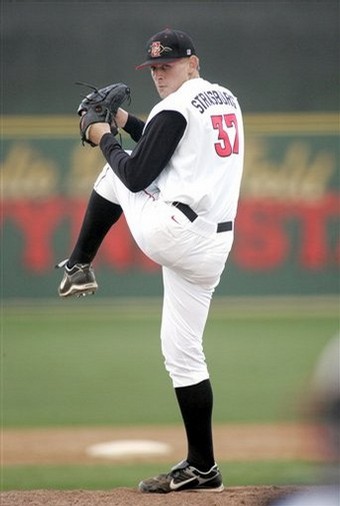
Photo Credit: AP Photo
A Method to the Madness
Somehow, someway you’ve stumbled across this site. Congratulations. Did you know that every month the Netcraft Web Server Survey conducts a survey on how many living, breathing websites are cohabitating on the World Wide Web? As of ten minutes ago, we sure didn’t. Their data from January 2009 shows evidence of 185,497,213 distinct websites existing on the internet. That’s a lot of websites. For better or worse, and hopefully for better, you can now add one more to the total. Here’s to the hope that this site represents the best darn .000000000539091657% of the internet possible.
In the end, our reasons for doing this are simple: we love watching about baseball, we love reading about baseball, and we love talking about baseball. We especially love the team building and roster construction aspects of the sport, particularly when it blends objective sabermetric data with subjective personal scouting. As an aside, this quote from Tony Blengino succinctly sums up how we feel about the whole stats vs scouts “debate” – “So it really is vital that statistics and traditional scouting work hand in hand for an organization to succeed, and I think you see that with the most successful organizations in the game; they do both well.” We also aren’t ones to toot our own horns, but we feel we’ve got a unique perspective on prospective big league talent, from countless hours spent observing and analyzing ballplayers firsthand at high schools, junior colleges, and four-year universities to the accumulation of raw data, empirical and otherwise, accessible to the public like never before.
We have a vision for what this site can be and we plan to do our very best to make sure that vision gets carried out. There is a framework in place outlining what we hope to accomplish, but it’s worth noting that a framework is exactly what we have right now. This was done intentionally as we believe a loose framework is the best way to present the information we’ve compiled and the opinions we’ve formed. This site was created with the intent to be malleable and responsive in order to give you, the reader, the kind of content you’d most like to see.
It’s important to begin with an explanation about how we plan to do what we plan to do. We like to think of this as the method to our madness. “Method” is the careful, systematic way that something intelligent is done. “Madness” is the strange, meaningless action of a crazy person. Our conclusions will not always be agreed upon by everyone, but we promise to always have a method that details how we came to those conclusions.
“Though this be madness, yet there is method in it.” – Polonius in Hamlet
- The method is simple. We will take into account any and all information from any and all reputable sources. These include, but are in no way limited to, firsthand accounts, statistical analysis, scouting reports from people in and out of the business we trust, and scouting reports from cited publications and sources we trust.
- We fully acknowledge that this is an opinion driven business. Baseball scouting is extremely objective and there can be no right or wrong answers so long as there is some meat to back them up. The goal of this site is to provide a place where a general consensus on draft prospects can be realized. We wanted to start this site because we felt our opinions were worth sharing. We also wanted to start this site to collect as much information on amateur baseball talent as possible, with the eventual goal of coming to an agreed upon consensus of where that player slots into a larger baseball universe. We may like a player a lot, perhaps more than the majority public opinion. We may think said player will be a very good big leaguer when others don’t quite see what all the fuss is about. However, in the grand scheme of things, our opinion doesn’t count for a whole lot at this point. Our goal is to not just provide our opinion of the player, but also the opinion of others within the game that will be more relevant to the player’s immediate future (for example: what round the player will be drafted in).
- We have three personal approaches when it comes to scouting an amateur baseball game. They all have their pros and cons and we try to mix them up. We have our opinions about which works best, but know that one of these three basic methods will always be followed.
- Comprehensive: Study the numbers beforehand and go into the game knowing who and what to watch for, deviating only if something special catches your attention.
- Blind: Ignore the information presented before hand and just trust your eyes to tell you who can play and who can’t. After the game, run through the numbers and see what matched up and what didn’t.
- Oddities: Scan the numbers quickly, but only to see if there are any statistical outliers that warrant concentrating more time watching a particular player or three.
- This may be hearsay and a lot of those in the business will argue blue in the face otherwise, but we present this simple fact to you because, well, honesty is our policy: scouting is not exactly rocket science. We mean no disrespect to the job and the professionals (and they absolutely are professionals) who do it for a living. We have been involved in the game enough to feel comfortable watching a player and formulating an opinion based on what we see. Of course, we are not delusional. Many of the intricacies of the scouting profession remain blind spots for us. To help remedy that, we firmly believe in the scouting bell curve. There are rare times when you see a player and you just know, for better or worse, whether or not that player has it or doesn’t. We had one of those better reactions to a player when watching current Baltimore Orioles minor leaguer Matt Wieters play collegiately; right away, you knew he had everything it took to be a very high draft pick and a darn good big league player. Conversely, sometimes there is a player, highly touted or not, that has such obvious fundamental flaws to his game that you know straight away that it would take a minor miracle for him to realize his potential. Those are both extremely, extremely, extremely rare examples. Almost always, it takes repeated viewings of a player to even begin to formulate a meaningful opinion.
- We love player comps. Love ‘em. Lots of purists hate them, but we think there is no better way to draw casual fans of the draft in than through comparisons to current and former major and minor league players. They are also very useful when used as a conversation starter or as a summation of a player’s skillset; Player X reminds me of Player Y because…and boom! You’ve got a discussion going.
- Ah, the traditional scouting scale. It is used by a lot of different professionals in a lot of different ways. Every Major League team, to our most recent knowledge, currently grades players in increments of 5. All players are graded on the current abilities and their future potential. Here, it’ll be used as Cliff Notes. Rarely will we talk about players’ abilities on the scale numerically, but we will refer to their talents with the scale in mind. For example, if we talk about a college pitcher with a plus breaking ball, you can assume that breaking pitch rates between a 60 and a 65 on the scale. The simplest breakdown you’ll ever see on the scale (additional detail will be made available as we get rolling):
80 = “Eighty”
70 = Plus-Plus
60 = Plus
55 = Above Average
50 = Major League Average
45 = Below Average
40 and Under = Bad News
If one thing can be gleaned from this cobbled together introduction it’s this: Even if you don’t trust the analysis, this site will at least serve as a resource. Scouting has become more of a science than an art, but it’s a terribly inexact science. The effort to discover and increase understanding is what science is all about. The more information that the public has access to, the more everybody can learn. That’s all we want: to share what we’ve learned and to learn ourselves. Simple enough, right?
Remember our fun fact from the beginning? There are 185,497,213 websites on the internet. Sound familiar? Well, I figure the breakdown is roughly 185,497,200 or so porn sites (so I’ve been told), with many of the leftover sites devoted to the great sport of baseball. Baseball has a gigantic web presence, but there is simply not enough coverage of the yearly Rule 4 Draft. Time for us to do our part in changing that. Site number 185,497,214 is open for business.
 The Baseball Draft Report