
Home » Posts tagged 'Alex White' (Page 2)
Tag Archives: Alex White
College Baseball’s Second Friday Night – A Pitching Retrospective
This is a Strasburg-free zone (more or less), so get your fix of the big man over at Strasburg Strasburg Strasburg Strasburg Strasburg…
Highlights from the most notable pitching performances from the second Friday night of the college baseball. We’ve got great prospects, good prospects, and fringe prospects. Whatever you are in the mood for, we’ve got it. Well, as long as you are in the mood for college pitching prospects. If not, what the heck are you doing here? May I suggest a lovely knitting website that may better suit your interests?
Full report, after the jump… (more…)
2009 College Baseball Opening Night – A Pitching Retrospective
A look back on the pitching highlights from college baseball’s opening night. It’s not a comprehensive look back, it’s not an ultra-scouty look back, it’s not even an analytical look back. It’s just a quick and dirty review of how an assorted sampling of some of the very best arms in college baseball performed on Friday, February 20th. Before we get to all the recappy goodness, how about a recap of not how baseball players actually played, but of the work some dorky draft website did?
Who among us can resist the allure of the Big Board? The Top 50 College Draft-Eligibles are HERE, HERE, HERE!
How about a look at teams comprised of the best players from each college class, including the most mysterious and overlooked group of them all? The best college players available in 2010 and 2011 were also given the corny “All _____ Team treatment. We couldn’t ignore the men already caught behind the age relative to league minor league eightball, could we? Wouldn’t dare dream of it. Lastly, why not make yourself familiar with players who are actually relevant to this upcoming year’s upcoming draft by reading about the country’s best draft-eligible sophomores (sans middle infielders)…
I promise I won’t keep linking to myself like that. It’s tacky, I know. It’s just that the site is new, readership is slowly coming along and I don’t want anybody left behind, and, well, I’m trying to trick people into reading something other than just the mock draft. I’m not knocking the mock, heck I love it too, but the disproportionate amount of traffic it gets just cracks me up. Enough complaining, let’s get on with the show.
Onward and upward we go, spinning fast and furiously along the college opening night pitching performance review carousel…
Cream of the Crop
Stephen Strasburg (San Diego State): 5.2 IP 3 H 0 ER 2 BB 11 K 4 GO 1 AO 1 LO, 105 pitches
Alex White (North Carolina): 5 IP 8 H 3 ER 1 BB 9 K 5 GO 1 AO 90 pitches
Kyle Gibson (Missouri): 6 IP 3 H 0 ER 3 BB 6 K 6 GO 3 AO 1 LO
Mike Minor (Vanderbilt): 5.2 IP 5 H 2 ER 2 BB 6 K 3 GO 7 AO 1 LO
Kendal Volz (Baylor): 6 IP 2 H 1 ER 2 BB 5 K 9 GO 2 AO
Some really super awesome highly reputable website has these players respectively ranked 1st, 2nd, 5th, 6th, and 13th in their draft class, so, yeah, you know they are good. I’m not really sure what I can add to numbers that speak so darn well for themselves. Five pitchers, five good to very good pitching performances, five first rounders and millionaires come June. Yawn. Let’s just talk about Strasburg instead of going into all the nitty gritty details of the other quality starts of the quartet of college stars.
The Daily Aztec had an interesting look at the high school career and subsequent recruitment of the San Diego State ace. I’m not sure what kind of dough Rusty Filter is making, but now might be a good time to ask for a raise. The San Diego Union-Tribune has some pretty cool Strasburg related notes in a recent article, including some pretty weird quotes from an anonymous Phillies scout (“He’s definitely a two-pitch pitcher”…I think it’s meant as a compliment, but I hope the scout realizes he isn’t just a two-pitch pitcher, you know?) and a old flat out admission that I must have missed initially from Jim Bowden that Strasburg will be a National pending something terrible happening. Last but certainly not least, Rich Lederer was actually at the game and offered up this first-hand report of what ole Strasburg looked like on opening day. If you aren’t the type to typically click on a link (like me), I suggest changing your tune and following that one, if you have any interest in the best college player in the country anyway.
You know what I just realized? Every time I try to type out Strasburg’s name, every single time, I make the same typo. Stephen Starsburg. My fingers won’t let me type it any other way without really, really concentrating. I wonder if my hands know know something my fingers don’t…
(In the effort of full disclosure, in the first typing of the paragraph above I inverted letters in both the words “hands” and “know.” So, maybe it’s not a sign of wonderful things to follow for young Strasburg. Maybe it’s just as simple as me being a poor typist…)
Starter or Reliever?
Louis Coleman (LSU): 5 IP 2 H 2 BB 8 K 2 GO 4 AO 74 pitches
Ryan Berry (Rice): 4.2 IP 4 H 5 ER 5 BB 3 K 6 GO 3 AO 1 LO
Preston Guilmet (Arizona): 4 IP 5 H 0 ER 2 BB 6 K 3 GO 2 AO
Brad Boxberger (Southern Cal): 6 IP 1 H 0 ER 6 BB 11 K 2 GO 2 AO 120 pitches
As you can probably ascertain from their lines, all four of the young men listed above started the first game of the season for their respective college teams. Reports have Boxberger’s velocity falling off quickly after the first inning (and again after the second inning), a trend that jives well with his scouting reports heading into the season. While it’s almost always a good thing to exhaust every avenue, boulevard, and throughway that leads to a pitcher starting rather than relieving, you’ve got to wonder if it’s the right thing for a college coach to have a pitcher with professional aspirations tied to potentially being an elite reliever someday throwing 120 pitches in a game. Who am I kidding? You don’t even have to wonder. It’s bad. Research shows us this. Even if you are on the side of the debate that says pitchers are babied and pitch counts are overrated, come on – 120 pitches in the first game of the season? What’s the point? The fact that Boxberger is looked at as a potential reliever by scouts is just icing on the shortsighted, irresponsible cake. If you as a manager can help it, no pitcher should throw 120+ pitches in a single game ever, let alone on February 20th, right? It’s not good for the player and, if you stop and think for a second, it’s not good for the team, either. Is squeezing one extra inning (or two) out of a starting pitcher in a non-conference game so early in the season worth the potential damage an injury or even fatigue could have on the ballclub? Maybe there is more to the story that I simply don’t know, but from where I’m sitting Chad Kreuter has some answering to do.
Phew, I feel a bit better now. As for the other guys, both Berry and Guilmet are no doubt about it college starters who may be converted to relief as professionals. Louis Coleman is an interesting case because he may actually have just good enough stuff to survive professionally as a swingman/special usage long reliever if he shows he can start for LSU. That’s arguably an upgrade over simply topping out as a generic middle reliever, depending on your own personal philosophy on bullpen usage.
Draft-Eligible Youngsters (Sophomores)
Brooks Raley (Texas A&M): 6 IP 5 H 1 ER 1 BB 6 K 3 GO 7 AO 1 LO 79 pitches
Jeff Inman (Stanford): 7 IP 9 H 5 ER 1 BB 3 K 12 GO 4 AO
Hard not to be impressed by Raley’s debut effort, all the way down to the efficient way he went about his business. Inman’s numbers aren’t nearly as pretty, but the strong groundballing start is promising. The groundball numbers fit his scouting profile (strong sinker), but the lack of dominance (namely the poor K/IP rate) is something that needs a turn around this season if Inman wants to get into the first round – a spot in the draft that some think he can rise up to. I don’t buy Inman as a first rounder at all, so I’ll amend that last statement to say I personally he’ll need to show he can put hitters away in college if he wants to be a first three rounder this spring.
2010’s
Deck McGuire (Georgia Tech): 7 IP 3 H 0 ER 1 BB 13 K 3 GO 4 AO
Chris Hernandez (Miami): 6 IP 3 H 1 ER 3 BB 7 K 11 GO 1 AO 95 pitches
Sammy Solis (San Diego): 6 IP 4 H 1 ER 0 BB 9 K 7 GO 1 AO
Let’s combine these lines real quick and take a moment to bask in all it’s young pitchery glory:
19 IP 10 H 2 ER 4 BB 29 K 21 GO 6 AO
That’s good for an ERA of 0.95, a K/9 of 13.74, and a GO/AO ratio of 3.5. Even that Strasburg guy would be jealous of numbers like that. Hernandez is a fascinating prospect (I say that about a lot of guys, don’t I?) in that he has put up tremendous results at Miami in his young career, but lacks traditionally dominating stuff. Perhaps the 11/1 groundball to flyball number is a bit of a clue to how he has been so successful. If I get the time/patience/energy, I’ll have to go through the Miami game logs from last year and see what his 2008 ratio looked like.
New on Campus
Austin Dicharry (Texas): 1 IP 1 H 0 ER 1 BB 2 K 1 GO 0 AO
Sonny Gray (Vanderbilt): 3 IP 3 H 0 ER 1 BB 3 K 5 GO 0 AO
Two pretty sharp collegiate debuts for two of the finest young righties the class of 2011 has to offer. Gray’s 3 innings out of the Vandy pen were especially good, as 8 of his 9 outs recorded were either grounders or strikeouts and his lone walk was an intentional one. I can’t even imagine what it’s like to be a college hitter getting the 1-2 punch of Mike Minor and Sonny Gray all in one afternoon. My head might literally explode. That may sound gross, but keep in mind I’d hopefully be wearing a helmet at the time, so much of the splatter would be contained. I’m not sure how talking about exploding head splatter is any less gross (or anyway related to baseball), so we’ll just quietly pretend I didn’t say that and move on. Oh, and while we are pretending we have to also pretend I don’t have a functional delete key, thus explaining why I decided to keep such a stupid couple of sentences rather than delete them. Make-believe is fun!
Real Deal College Relievers
Scott Bittle (Mississippi): 1 IP 1 H 0 ER 0 BB 1 K 1 GO 1 AO
AJ Griffin (San Diego): 2.1 IP 2 H 0 ER 1 BB 4 K 2 GO 1 AO
Jason Stoffel (Arizona): 1 IP 3 H 1 ER 0 BB 2 K 0 GO 1 AO
Robert Stock (Southern Cal): 1 IP 0 H 0 ER 0 BB 2 K 1 GO 0 AO 12 pitches
I probably should have this group directly after the “Starter or Reliever” group, but that would require many seconds of copying and pasting that I can ill afford to spend on something so tedious. You see, I’m far more important to be bothered with such foolishness. It’s a much better use of my time to wonder aloud (in print) “What the heck happened to Jason Stoffel on Friday?” I also need the extra seconds to spend time pontificating about the wonderful debut of Robert Stock. Consensus opinion may have turned on you, buddy, but I still think you’re a keeper. Not too many players can get on base three times (including 2 hits, one a double), throw out two runners trying to steal second, and pitch a perfect ninth inning throwing low-90s heat. All that and he’s still only 19? Sign me up.
Random Lefties For Whom I Could Think of No Other Clever Unifying Characteristic
Rob Rasmussen (UCLA): 5 IP 2 H 0 ER 1 BB 5 K 6 GO 3 AO 1 LO
Tanner Robles (Oregon State): 5 IP 3 H 3 ER 4 BB 2 K 7 GO 4 AO 1 LO
Nick Hernandez (Tennessee): 5 IP 9 H 3 ER 1 BB 5 K 4 GO 5 AO
A mixed bag, for sure, but since when are lefthanders anything but? Robles and Hernandez went head to head, with nary a player coming out ahead of the other. Is that the correct way to use “nary”? And I am supposed to put the question mark outside the quotation marks, right? I know a period goes inside, but I’m pretty sure I remember the question mark being an oddball. Not unlike our quirky group of lefties here, see? Ah, full circle. Love that symmetry.
2009 MLB Draft: College Big Board 1.0
1. Steven Strasburg (RHSP – San Diego State)
Alright, so far this is pretty easy…
2. Alex White (RHSP – North Carolina)
3. Grant Green (SS – Southern California)
4. Dustin Ackley (OF – North Carolina)
5. Kyle Gibson (RHSP – Missouri)
White is a confusing prospect. On one hand, he’s second on the board and, while Green may be very close behind him at number three, is a worthy candidate to go number two overall. On the other hand, if we pretended Strasburg wasn’t draft-eligible this year, would White as the number one pick in the country feel right? That may be a silly way of looking at it, but I can’t help it. Maybe it’s more about my personal hangup about what a number one overall pick should be. I like White a lot and genuinely believe he can front a big league rotation, but it would feel like a weak draft if he went number one overall. Ugh, that makes no sense. I’m just thinking out loud, disregard this paragraph…
6. Mike Minor (LHSP – Vanderbilt)
7. Tanner Scheppers (RHSP – Fresno State/St. Paul Saints)
8. Aaron Crow (RHSP – Missouri/Forth Worth Cats)
9. Andrew Oliver (LHSP – Oklahoma State)
Minor is a personal favorite and higher on this list than he’ll sure be on others – watching Cole Hamels every fifth day the last few years has turned me into a huge backer of lefties with plus changeups. Scheppers is also higher here than he’ll be on most rankings, but, remember, this ranking is based on the assumption of good health into the summer.
10. Josh Phegley (C – Indiana)
11. Mike Leake (RHSP – Arizona State)
12. James Jones (LHSP – Long Island)
13. Kendal Volz (RHSP – Baylor)
14. Mike Nesseth (RHSP – Nebraska)
Phegley as the third ranked college bat may seem a little strange, but his statistical profile is hard to ignore. He heads up an underrated group of college catchers that feature a surprisingly high number of players on the list – well, maybe it isn’t all that surprising, but it was surprising to me as I put the list together, whatever that’s worth. Leake over Volz is a little strange, but it came down to present plus command and movement over potential power plus stuff across the board.
15. Sean Black (RHSP – Seton Hall)
16. Jake Locker (OF – Washington)
Sometimes I have a hard time letting go. I know I previously admitted having Locker = poor man’s Grady Sizemore burned into my brain, but Sean Black this high could be just as egregious a selection. Black was a big prep prospect not too long ago who has failed to live up to the hype at Seton Hall. Loads of raw talent + more difficult playing conditions (subpar team, so-so conference, and colder weather) = potential sleeper prospect. Locker will fall down the list (and eventually off altogether) as other players emerge this spring, but I had to put him way up here as a nod to his prodigious talent.
17. Kentrail Davis (OF – Tennessee)
18. Robbie Shields (SS – Florida Southern)
19. Jared Mitchell (OF – Louisiana State)
20. Kyle Seager (2B – North Carolina)
21. Rich Poythress (1B – Georgia)
Counting Locker at 16th, that gives us sixth straight position players in a row. How about that? These five should all be big league starters if all goes according to plan, though only the two outfielders profile as potential all-stars.
22. Sam Dyson (RHSP – South Carolina)
23. Chris Dominguez (3B – Louisville)
All or nothing, here we come. Dyson’s arm is electric, but his injury history and control both need some cleaning up. Dominguez has his detractors, but two plus tools (arm and power) make him stand out in a weak college class for hitters. If he puts it all together this season, expect crazy power numbers out of Dominguez, especially in Big East play.
24. Ryan Ortiz (C – Oregon State)
25. DJ LeMahieu (SS – Louisiana State)
26. Trevor Coleman (C – Missouri)
27. Robert Stock (C – Southern California)
28. Ryan Jackson (SS – Miami)
Five spots, only two positions. Sorting out the college catchers and middle infielders is one of the trickier things to do in this class. Ortiz is an underrated player because his skillset is so broad. Players like this often get overlooked for not having one standout tool to suck scouts in. LeMahieu is a far better hitter than Jackson, but they are close in the overall rankings because Jackson’s defense is outstanding. Big league front offices realize the importance of quality defense now more than ever, so where Jackson falls on actual draft boards will make an interesting case study in just how focused teams are developing their own standout defenders through the draft. As I already wrote about in the mock draft, Stock = catching version of Sean Black. Of course, baseball is a weird game so there may be more to the story than that simple equation (I like equations, by the way…if you haven’t noticed. We might be able to claim that Stock = Black without the catching disclaimer if the Southern Cal product has a big season on the mound for the Trojans.
29. AJ Pollock (OF/2B – Notre Dame)
30. Jason Stoffel (RHRP – Arizona)
31. Bryan Morgado (LHSP – Tennessee)
32. Kyle Heckathorn (RHSP – Kennesaw State)
Pollock is a hard player to figure, but if the position switch to second base actually sticks, he’ll fly up draft boards this spring. He is a very good basestealer, has playable pop, and is difficult to strike out. Pollock is one of the few I haven’t seen play yet, so I’m just throwing this out there…what about Chone Figgins as a comp?
33. Ben Tootle (RHRP – Jacksonville State)
34. Shawn Tolleson (RHSP – Baylor)
35. Jake Cowan (RHSP – San Jacinto JC)
36. Blake Smith (OF/RHSP – California)
The first junior college player to make the list is a righty with a great frame, 95 MPH fastball, and three plus pitches. Cowan, the former Virginia recruit, will be in contention to be the first juco player picked in 2009.
37. Tyler Lyons (LHSP – Oklahoma State)
38. Jeff Inman (RHSP – Stanford)
39. Ryan Weber (RHSP – St. Petersburg JC)
Weber is the second junior college arm on the list, a fact worth noting because neither the aforementioned Jake Cowan or Weber is Daniel Webb. Webb, the consensus top junior college talent, failed to crack the top fifty. Blazing fastball or not, he was just too raw a prospect for our tastes.
40. Micah Gibbs (C – Louisiana State)
41. Matt Thomson (RHSP – San Diego)
42. Brad Boxberger (RHRP – Southern California)
43. Tommy Medica (C – Santa Clara)
44. Brad Stillings (RHSP – Kent State)
45. Steve Fischback (RHRP – Cal Poly)
46. Nick Hernandez (LHSP – Tennessee)
47. Gavin Brooks (LHSP – UCLA)
48. Jordan Henry (OF – Mississippi)
49. David Hale (RHSP – Princeton)
50. Ben Paulsen (1B – Clemson)
And that’s 50. Not a very inspiring last group, but, let’s be real, it’s not a very exciting year for high-end college talent. I think I picked the wrong year to start doing this…
Check back all weekend long for occasional updates on college baseball’s opening weekend.
2009 MLB Mock Draft 1.0
First, an apology. The Angels have picks 25 and 26 from the Mets and Yankees respectively, the Mariners have pick 28 from the World Champion Philadelphia Phillies, and the Rockies have the Angels pick at 33, the last pick of the first round. This mock took a bit longer than anticipated to complete, so it still reads as if the original draft order stands. Subsequent versions will have the updated order and picks. Please accept my apology in the form of a 6,511 word mock draft written for an event four and a half months away. Full first round mock draft after the jump…
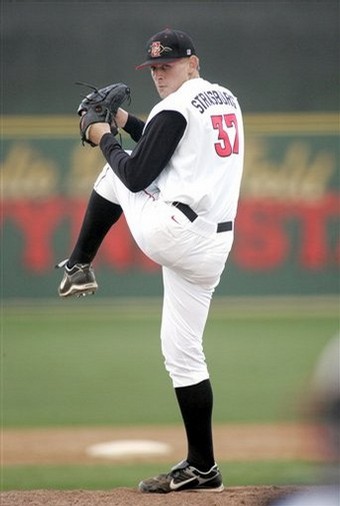
Photo Credit: AP Photo
 The Baseball Draft Report