
Home » 2009 MLB Draft (Page 4)
Category Archives: 2009 MLB Draft
A Quick Word on Three College Catchers
Josh Phegley doesn’t deserve all the fun, does he? Time to give a little bit of love to the three left behinds in yesterday’s second to last (thankfully) top college catching prospect tournament or whatever the heck I’ve been calling it. Anyway, the losers yesterday were Tommy Medica, Justin Dalles, and Travis Tartamella. In no particular order, here are three college catching prospects that I think will be among the first ten or so best in the 2009 Rule 4 Draft…
Photo Source: Ben's
2009 Draft-Eligible Top College Catcher Tournament (Part III)
It’s been a while since we started this thing up, so take a minute to check out a link or two to see what the heck we’re doing here – Part I and Part II. Who is the best draft-eligible college catcher in all the land? We’re going to find out tournament-style! Next up, the four participants facing off in our very special Joe Mauer Regional…
Joe Mauer Regional
1. Josh Phegley
4. Travis Tartamella
2. Tommy Medica
3. Justin Dalles

No suspense here, I’m sorry to report. After upsets in the first two regionals (Stock and Fleury), Josh Phegley blows away all comers here in the Joe Mauer Regional. It’s no surprise, really, as many publications have Phegley safely ensconced as one of the top two college catchers in all the land and a great bet to be off the board by the end of round two. We’ll talk about the other three names at a later date (I like Dalles over Medica, injury or not, by the way), but for now we’ll shine the prospect spotlight on the champ.
I’m excited for June 9 for all sorts of reasons. There are plenty of draft storylines that deserve more press coverage than they’ll inevitably get, but I hope the eventual destination of Josh Phegley gets a little bit of love come draft day. By the numbers, Phegley is truly a standout amongst a group of less than stellar college bats. There is no denying this man’s college production. So where will he land and when? Teams that place a greater importance on statistical performance will be hard pressed to find a better college prospect than Indiana’s star backstop. His numbers both in and out of context are staggering —> .438/.507/.746 with a 34/22 walk to strikeout ratio his sophomore year and .383/.485/.688 with 29 walks to 23 strikeouts so far this year, all while playing home games in a neutral park in the chilly north. To find fault in Phegley’s collegiate numbers is to complain about a stray splatter on a Jackson Pollock.
Phegley’s production has been top notch, but what about his projection? This is where things get more complicated. There are doubts surrounding his defense, his pro power potential, and his bat speed. To be fair, no college hitting prospect this side of Rich Poythress (though even he gets dinged for being limited to first defensively) comes without warts, but the fact that Phegley’s detractors knock his bat so severely is telling. My quick and dirty notes from watching his swing over a few games earlier this season:
- Pronounced crouch (a little like Aaron Rowand’s), good leverage and balance
- Circles bat pre-swing as timing mechanism; keeping hands high is key – when they drop, so does his power
- Uneven feet with his back leg staggered back in box, impressive in the way his lower half moves in sync with the rest of his body during setup and follow through
- Lets ball get unusually deep, but his wrists (more strong than quick) help his plate coverage – Phegley can afford to wait and wait and wait because, at worst, he has a knack for fouling balls off until he gets one he can drive
- Swing gets knocked for being long, but I saw it level and surprisingly compact and efficient; the helicopter finish may slow down the swing enough to give certain teams pause
I’d agree with a scout that questions Phegley’s future power potential as his swing is closer to that of a player with consistent line drive, gap power. I’m not sure I’d worry as much about a slow bat, but I do think some tweaks (namely toning down the finish a smidge) could help him shave some time off his swing and perhaps unleash a little bit of the power he loses with his level, one-plane swing.
Phegley’s defense is a topic that has generated plenty of discussion in scouting circles because, well, scouts love talking about an otherwise solid player’s glaring deficiency. Phegley’s defensive tools are solid as he possesses an average to above-average throwing arm with a quick release, but his shoddy footwork and consistent struggles blocking balls in the dirt keep his present defensive grade below-average.
Despite the fact that many of the specific concerns about his defense are valid, he’ll stick behind the plate as a professional. The aforementioned tools are there for Phegley to be an average defensive player and with a bat like his that should be enough. Picture an offense-first, slightly below-average to barely average defender behind the dish. A peak that looks a little something like Michael Barrett’s (2004-2006) with much better plate discipline (one of Phegley’s biggest and most unique strengths) sounds like a reasonable enough upside for Phegley going forward. For those looking for a decent prospect comp, I’ve got two names to consider – Phillies catcher Lou Marson (with a little more juice in his bat, but less glove) and Rangers catcher Max Ramirez (with less power, but better defense).
In the end, I think a Marson comp (right down to their similar level swings) makes the most sense with a more patient Barrett-like peak well within reason. One of the perks of an established college player with a strong statistical history like Phegley is the near elimination of the total bust factor; it’s hard to see Phegley completely flaming out as a pro, he’s had too much success against high level competition to bet against him at least reaching the bigs as a backup. With a ceiling of Mike Barrett and a floor of Josh Bard (high level backup deemed not quite good enough to catch full-time, but productive when given opportunities). There’s some very real value there, especially considering the typical dearth of catching prospects throughout baseball. It remains to be seen how far down the top prep college catchers will push the college guys on draft day, but Phegley’s statistical profile and good enough tools could get him picked anywhere from late in the first (to a competitive team in need of a quick moving catcher…Tampa? Boston?) to the middle of the third round. I’d take him over any other college catcher, but probably not until midway through the second round.
Stephen Strasburg (Again) and Site Updates (Again)
Another weekend, another dominant Stephen Strasburg performance.
Against a nationally ranked TCU team that we talked about before: 7 IP 4 H 3 ER 1 BB 14 K
His season numbers are silly: 70.1 IP 45 H 13 BB 135 K (7 WP 2 HBP 1 BK)
I’ve run out of things to say about him because, really, the numbers speak for themselves. I really can’t wait for his first start at Nationals Park when all the baseball world’s eyes will rightfully be watching the debut of the most acclaimed amateur baseball prospect ever.
_____
Busy week ahead, so it only makes sense to get some of the bookkeeping out of the way early. A few quick things before we move on to bigger and better…
- 4 correct picks on the NFL Draft mock from Friday. 4 out of 32. I picked winners at a 12.5% success rate. Boy, is that bad. The worst part is I can’t promise the final MLB mock will be any better. Maybe I’ll dig up the one I did elsewhere last year and see how poorly I did…probably wasn’t much better than 12.5%.
- What do you think of the new site layout? I had a focus group of one help me pick it out, but I’m curious to hear if the switch is for the better or if more tweaking should be done. Come to think of it, the switch may not be noteworthy enough to comment on…I’m not sure I’d comment on somebody else’s site redesign at this stage in the game (we’re only two and half months in after all) for fear of getting invested in a site only to see it disappear like so many others seem to do. Then again, maybe I’m just weird like that. I probably shouldn’t equate commenting on a redesign with an emotional investment, but that’s exactly what I just did.
- I’m finally getting around to throwing up some links on the righthand sidebar. If you have a link that you think should be there, let me know. Same thing goes if you have any ideas for useful baseball related sites that I’ve yet to link to, as well as any team specific sites that don’t already have a link. The idea is to get a good, informative team site for all 30 MLB squads, but it’s harder to find good, informative team sites that place an emphasis on prospect development and the draft (Phuture Phillies and Future Redbirds, no relation, are two of the prototypes for this model) than I originally had thought. I started putting up a few already, but decided to wait and see for a little bit in case anybody out there has any insight into what direction I should go with the others.
What A Jackass
I really, really, really hope this doesn’t become a recurring feature here, but I’m just about positive that it will be. It’s time to look back through the archives and have a good laugh at something stupid stuff I’ve said. The only hard part is narrowing down which dumb thing to choose…
This particular rambling thought was from March 1, 2009. It’s not necessarily the dumbest thing ever put in print (notice my wonderful use of qualifiers and hypotheticals), but it’s certainly looks silly in hindsight. Behold my genius after the jump…
2009 MLB Draft – First Round Tiers 2.0
Another week, another crack at separating the first round of the upcoming draft into tiers. Alright, that’s not entirely true — it’s been almost three weeks since we first did this — but calling this a triweekly isn’t nearly as catchy, plus it’s way more confusing. Did you know triweekly can either mean “three times a week” or “every three weeks?” How can a word mean such different things and get away with it? English, what a silly language…
This is a modified, way wimpier version of the tiered breakdown from three weeks ago. I’m sticking to players that are stone cold locks to go in the first round only. I have the utmost confidence that the following players will be first rounders in June.
- Tier 1 –> 1 player
Strasburg
- Tier 2 –> 9 players
Dustin Ackley/Kyle Gibson/Aaron Crow/Alex White/Grant Green
Shelby Miller/Tyler Matzek/Matt Purke/Donovan Tate
- Tier 3 –> 6 players
Mike Leake/Tanner Scheppers/Rich Poythress
Luke Bailey/Zack Wheeler/Tyler Skaggs
That’s my new line of demarcation. 16 players that seem like sure bets to go in this year’s first round. If I wanted to get it up to an even twenty, I’d add the LSU duo (LeMahieu and Mitchell), my new favorite prep position player (yes, I’ve finally come around to Bobby Borchering), and this week’s fastest riser, lefty Rex Brothers of Lipscomb. I’m hesistant to call any of those players locks at this point, but I reserve the right to be a wimp for now.
Where am I wrong? Which player listed won’t be a first rounder? (Tyler Skaggs?) Are there any names left off the list that will be guaranteed first rounders that I missed? (Max Stassi? Matt Davidson? Andy Oliver? Austin Maddox? Brett Jackson?)
First Five Picks Explained
Nothing else prepared for a Monday morning, so why not a teeny bit of explanation on the first five picks guessed at on the latest top ten mock?
1.1 Nationals/Strasburg
A gimme, right? The seven syllable line about the money (“Twenty mil sounds about right”) is about where I stand as far as where any potential Strasburg/Boras bonus demands will lead. He’ll smash the old draft signing bonus record, sure, but it will far way short of any of the big numbers being floated between now and the draft itself. In other words, twenty mil sounds about right…
1.2 Seattle/Ackley
I’ve mentioned this before, but it bears repeating – something good is brewing in Seattle and it begins with the huge emphasis the new regime has put on stockpiling quality defensive players. To project Ackley to Seattle is to give up the dream that he’ll ever be the centerfielder; having seen him play on multiple occasions, I’m pretty confident in claiming that, at best, he’d be nothing more than a league average defender if forced to play CF. If Seattle loves the bat as much as I do, they’d be wise to call him a LF/1B from the start and just let the man hit.
1.3 San Diego/Crow
No real indication about which way the Padres are leaning, but the front office did publicly comment on the dearth of pitching in the system as recently as a few months ago. I know that’s the not the best reason in the world to have them pass on Grant Green, a player who would fill a gigantic organizational need, but it’s all I’ve got right now. In my head, this pick came down to Crow or Tyler Matzek.
1.4 Pittsburgh/Green
Seriously, Green could be joining fellow up the middle talents like BJ Upton and Matt Wieters if anybody running this club had any common sense. Fans at PNC Park could be getting excited about adding another potential impact bat to a lineup that, in our bizarro world, would soon feature Upton/Wieters/Pedro Alvarez. I had an alternate haiku that managed to feature both Operation Shutdown (which is mentioned in Derek Bell’s wiki page, but really deserves a special entry) and Daniel Moskos, but decided to spare any Pirates fan and left it on the cutting room floor.
1.5 Baltimore/White
Who knows if Baltimore really believes that the best way to beat the big spenders and savvy front offices of the AL East is by getting as much young pitching as possible, but with Green off the board it is hard to see the O’s taking anybody but a pitcher this early. Matzek, Kyle Gibson, and Shelby Miller all make sense, but White’s blend of big game college experience and untapped potential will be enough for them to overlook his sometimes questionable mechanics.
Quick Friday Top Ten Mock

High card in the deck
Twenty mil sounds about right
More hype than Barack
1.2 Seattle Mariners – Dustin Ackley
Z’s first draft as boss
Will defense dictate the pick?
No, instead Gwynn twin
1.3 San Diego Padres – Aaron Crow
Pads secret code
Yes, “the Crow flies at midnight”
Sorry, that was lame
1.4 Pittsburgh Pirates – Grant Green
Recent failures sting
Imagine this young core group
Green, Wieters, Upton…
1.5 Baltimore Orioles – Alex White
O’s new strategy
Slay East goliaths on mound
White needs his slingshot
1.6 San Francisco Giants – Donovan Tate
First prep player popped
Same tools as Carlos Beltran
Football? Zero chance
1.7 Atlanta Braves – Tyler Matzek
Home state player gone
Choice of prep port or starboard
Can’t beat the upside
1.8 Cincinnati Reds – Kyle Gibson
A perfect marriage
Groundballs and overworked arm
Fits ballpark, Dusty
1.9 Detroit Tigers – Shelby Miller
Grab righty and pray
System as down as GM
Cars and Dombrowski
1.10 Washington Nationals – James Paxton
Signability
Target rising college guy
Hey, I’d sign for slot!
2009 Draft-Eligible Top College Catcher Tournament (Part II)
Who is the best draft-eligible college catcher in all the land? We’re going to find out tournament-style! Robert Stock shocked the world…or the 400 people who read this site a day…and won a spot in the Final Four yesterday. Today, four more participants face off in our very special Mike Ivie Regional after the jump…
Mike Ivie Regional

- Source: Baseball Almanac
2009 Draft-Eligible Top College Catcher Tournament
Who is the best draft-eligible college catcher in all the land? We’re going to find out tournament-style! First up, the four participants facing off in our very special Steve Chilcott Regional…
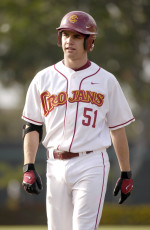
Photo Credit: usctrojans.cstv.com
Steve Chilcott Regional
1. Ryan Ortiz
4. Dan Black
2. Robert Stock
3. Anthony Sosnoskie
The Chilcott Regional, brought to you by the first overall pick of the 1966 Draft and one of only three top picks never to reach the big leagues (Brien Taylor and Matt Bush being the others), is headed up by one of the most athletic catchers in the country, Ryan Ortiz of Oregon State. Ortiz has a slightly above-average arm, but it plays up because of a very quick release. He’s got a big league frame (6-3, 205), but it’s more of a wiry, athletic build than a classic catcher’s body. He has limited upside with the bat because of unimpressive swing mechanics and his setup at the plate leaves plenty to be desired, but he has shown a very mature approach at the plate in his two years starting for the Beavers.
I think Ortiz would be lucky to have a pro career that follows the Eli Marrero/Mitch Maier path – getting at bats as a super-sub capable of filling the role of backup catcher, reserve corner outfielder, and occasional corner infielder. That’s not a knock, by the way; more young players would be better served by playing up their strengths (in Ortiz’s case, his above-average athleticism and experience at multiple positions on the diamond) and accentuating the positives in their games. Do everything in your power to be a great big league starter, of course, but if things don’t work out as planned then don’t fight a utility future, embrace it.
The challenger, Black, is a totally different animal. His oversized frame (6-4, 220) delivers exactly the kind of punch you’d expect – plus raw power and a plus throwing arm. In my world, a few plus tools beat the heck out of a ton of solid-average ones. In fact, in looking at the little bit of research I did a while back about why so many college catchers fail, I came to the following conclusion:
Catching prospects that fail seem to fall into three central categories: no stand out tools (for some reason players that are supposedly solid in all phases in the game don’t tend to pan out at the position), a string of developmentally damaging injuries (pretty self-explanatory), and more D than O. So all you have to do is find that offensive-oriented catcher with above-average tools and a clean injury history. Easy as that, right? Interesting to note that Jeff Clement, the highest drafted college catcher of the decade, only really fit one of the three criterion – he was an offense first prospect with question marks about all of his non-hit tools and creaky knees. He is still a good prospect, but he’s now 25 years old and back in AAA. Hmm.
Yes, I realize that’s hardly a groundbreaking conclusion, but it’s all I’ve got. Anyway, Black’s two standout tools give him the edge over Ortiz. Simplistic, I know. Sometimes it’s just as easy as that.
Plus raw power and plus arm strength > above-average arm, athleticism, solid contact skills, and below-average power. Black has the higher ceiling (big league starter either at catcher or third base), but Ortiz has the higher floor (his positional versatility is very appealing)In an upset, Black knocks out consensus favorite Ortiz to move on to the second round. Gee whiz, isn’t this fun?
The second matchup isn’t quite as entertaining. I remain a stubborn, stubborn man when it comes to Robert Stock’s catching potential. We’re at the point when almost everybody in the free world sees Stock as a pitcher, but me. You’d think that would be enough to convince me to give up the obsession with his unrealized upside behind the dish, but you have no idea the depths of my stubbornness. I still see the prep version of Stock that tantalized with plus arm strength, plus athleticism, and a projectable frame with lightning quick wrists that had scouts predicting he’d hit for as much power at Southern Cal than Jeff Clement. His mid-90s heat and potential plus curve have scouts believing his professional home will be on the mound, especially now that he’s getting starters innings as a pitcher for the Trojans, but I remain steadfast in my belief that his upside as a catcher hasn’t totally vanished despite three lackluster years at the college level. In a catching crop chock full of players with limited upside, Stock’s true talent level stacks up with all but a select few. Sosnoskie is a little bit like the anti-Stock in that he offers well above-average defense at present, but with a lot less offensive upside. He has shown a good bit of progress with the bat so far in 2009 (leading the Hokies in homers and rocking a 26-15 BB/K ratio), but it may be too little too late to change the perception that he’s a backup catcher at best in the pros. He’s pretty clearly in the lower half of the top 16 college catching prospects, and it will be interesting (to me, anyway) where he’ll eventually stack up against players with similar skillsets on draft day. Anyway, Stock wins this one going away.
4. Dan Black
2. Robert Stock
Two of my top five catchers (spoiler alert!) square off in the Chilcott Regional Final. No need to change my stubborn ways now, right? The winner is Stock but only by the tiniest of margins. It’s downright silly to compare any player to Baltimore phenom Matt Wieters, and it’s even sillier to compare the loser of a competition like this to such a stud prospect, but the scouting reports on Black all read like very poor man’s versions of Wieters. I’m not even sure what a comp like that means (what can we really expect out of a very poor man’s version of Wieters?), but it is just too sexy a comparison to ignore. Even still, give me Stock and that upside that only I still believe in, fool that I am. Welcome to the Final Four of College Catchers, Robert Stock.
The Field of 16 – Top College Catching Prospects
It’s about time we got back to doing some positional rankings around these parts, don’t you think? We covered the top prep righthanded pitching prospects here, here, here, and here, as well as the top college righthanded starting pitching prospects here, here, and here. After a bit of a break, it’s time to jump back in this time with college catching prospects, a topic danced around but never ranked both here and here. Because straight rankings can become a little tiresome after a while, I decided to do something different with the catching prospects. Will it be cool? Will it be super lame? Will it be more confusing and time-consuming than it’s worth? Stay tuned! The top 16 college catching prospects in all the land after the jump, as well as the unveiling of just how we’ll be ranking them this time…
Strasburg 4/8/2009
With the holiday weekend causing a scheduling shift around college baseball, usual Friday starter Stephen Strasburg takes the hill on a Thursday to lead off San Diego State’s series at UNLV. We all know what Strasburg has done to this point, but it never hurts to throw out his season numbers so far – unless, of course, you’re a fan of the Mariners…
On the season, Strasburg has struck out 94 batters while only walking 10 in 48.1 innings pitched. Opponents are hitting a whopping .160 against him so far (27 for 169). He’s good.
He’ll be facing a decent UNLV lineup, but one built on very few interesting pro prospects. In fact, Strasburg has faced UNLV once already this year and put up the following line: 7 IP 6 H 2 ER 1 BB 14 K. Again, he’s good.
This time, however, Strasburg will be going to UNLV’s Earl E. Wilson Stadium, a hitter’s paradise with a park factor of 121. How will he fare the second time up against the Rebels? How will he adjust to pitching in an even friendlier hitting environment than his own home park? We’ll know soon enough. Until then, a look at the three best UNLV hitting prospects that Stephen Strasburg will face tonight…after the jump
Unranked Ranking of 2009’s Top Twenty Prep Prospects
I’m still trying to get a feel when some of this year’s top prep talent will go off the board this June, so excuse me if this post comes across as little more than just some nut thinking aloud. The tiers below the jump are even more arbitrary than earlier iterations of the tier system, but they exist primarily as a means of separating the top talent while still allowing plenty of wiggle room in the future. Between not having any kind of worthwhile stats to go on, conflicting scouting reports, and fewer opportunities to actually see the guys play, evaluating the draft stock of high schoolers can be a real pain. Saying that one high school lefty is beyond a shadow of a doubt a superior prospect than another similarly ranked prospect is a fool’s game at this point in the process. (IMPORTANT NOTE: I am a fool who enjoys engaging in fool’s games very much, far more than I should probably, so expect plenty of Player X is better than Player Y talk on this site in the future…just not with high schoolers two months before the draft).
Instead, you get tiers for now. It’s mostly just an organizational piece for me, or a way of creating a launching pad (I love the mental imagery that evokes) for future high school draft talk. For now, mull over a quick top twenty of 2009 high school draft prospects – consider it a mix of where industry insiders have players ranked (Stevenson and Hobgood being two players with tons of helium right now that I’m not buying as elite prospects just yet) and a personal set of rankings chock full of my own special herbs and spices (as of now, I’m one of the very few on board with believing a player nicknamed Scooter is a top two round talent). It’s a difficult happy medium to reach, going with the consensus while also interjecting your own — hopefully informed — personal take, but ideally the end result is something worthwhile. Remember, the end goal here is simple…as the great Herm Edwards once said, “WE CAN BUILD ON THIS!”
Unranked ranking of the top twenty prep talents of 2009 after the jump
College Righthanded Starting Pitching Prospects – Comparing 2008 to 2009
If semi-incoherent ramblings about a very specific and unimportant topic with no readily apparent conclusion or point is what gets you going, be prepared to start your week off with something special. If not, congratulations – you’re normal. I’ve got a hunch that anybody out there willing to read some dummy’s baseball draft website probably isn’t “normal” anyway (and I say that with nothing but love), so why not just give in and see where our aimless thoughts will lead us today…
The top 15 righthanded starting pitching prospects as listed on this site, in descending order:
Jeff Inman, David Hale, Jake Cowan, Sean Black, Sam Dyson
Alex Wilson, Kyle Heckathorn, Mike Nesseth, Kendal Volz, Mike Leake
Aaron Crow, Tanner Scheppers, Kyle Gibson, Alex White
Stephen Strasburg
An updated list might look a little something like this:
Strasburg
Gibson/White/Crow
Leake/Scheppers
Dyson/Wilson/Berry
Volz
Nesseth/Heckathorn/Black/Cowan/Hale
Inman
The tiers align with the first round board tiers from last week, with the exception of Dyson rising up to join Wilson and Berry. Volz and Inman are especially difficult players to place, so they got their own private tiers – it’s the perfect solution for a lazy writer like me, really. Nesseth, Heckathorn, Black, Cowan, and Hale are all players that are personal favorites from my initial top 15, but have such mixed opinions that I’m lost on where to slot them in. I guess what I think is most important to take away from the bottom three tiers is that Volz is a clear step above the Nesseth/Heckathorn/Black/Cowan/Hale group (in the eyes of scouts) and Inman has dropped enough that he is clearly below the group (in my eyes). Further complicating the matter is Nesseth’s switch back to the Nebraska bullpen, but I’ll leave him in with this group for now because I still think his stuff works as a starter professionally.
Players considered for the list, but left off for now include Blake Smith (Cal), Scott Bittle (Mississippi), Jorge Reyes (Oregon State), AJ Griffin (San Diego), and Brad Stillings (Kent State). Smith’s status as a two-way player vexes me, Bittle’s stuff may actually work better as a starter/swingman in the long run, and Griffin is a gigantic personal favorite that will see his stock fly up my own personal rankings when I do my next revisions.
Notable players still missing from the list are the righty college relievers – Ben Tootle (Jacksonville State), Jason Stoffel (Arizona), Brad Boxberger (Southern Cal), and Brian Pearl (Washington) all profile best as relievers. Perhaps I can be convinced otherwise (Boxberger and Pearl might have stuff that would translate; Tootle and Stoffel are much better fits in the pen), but for now all four would strictly be drafted as relievers if I was running the show.
*****
For my money, the 2009 college righthanded pitching class absolutely trounces the 2008 class in terms of both quality and depth. However, the comparison between the two years is a tricky one to make because, and I really believe it’s as simple as this, the 2008 pitching class was an extremely weird one. The proponderence of college relievers made it an unusual draft at the time, but it’s gotten even weirder as we begin to see the long-term plans some of the big league teams have for their drafted relievers. Andrew Cashner, Joshua Fields, Ryan Perry, and Carlos Gutierrez were all college closers drafted in the first round. Of the four, it appears that only Fields and Perry are totally locked into their roles as professional relievers; Cashner and Gutierrez both may have the stuff to work better as pro starters. How do we then judge this class of pitching prospects? Are all four labeled as relievers? Does their eventual professional position carry more weight than their college position? How do we reconcile the fact that we don’t actually know the eventual landing spot of players like Cashner, Gutierrez, or Brad Holt? They may be given every shot imaginable to start, yet may work best as relievers in the long run. To simplify my life, I’m only going to evaluate players that were clearly scouted and drafted as starting pitchers.
The 2008 class was also a weird one because of the huge numbers of very talented players who slid down the board into the mid-rounds. These players were all almost cut from the exact same cloth – gigantic frames, big fastballs, questionable control and collegiate performance, and an inability to stay healthy. For this reason, it is my belief that this comparison would have been more enlightening if done with a pre-draft ranking of the available talent. Players like Chris Carpenter, Scott Green, Brett Hunter, Erik Davis, and Luke Burnett, to name a few, may have ranked higher on such a list. Kyle Heckathorn and Mike Nesseth, be forewarned.
2008 Top 15 College Righthanded Pitchers (7 college relievers, denoted with *)
Aaron Crow, Andrew Cashner*, Joshua Fields*, Ryan Perry*, Carlos Gutierrez*, Shooter Hunt, Brad Holt, Lance Lynn, Bryan Price*, Tanner Scheppers, Tyson Ross, Josh Lindblom*, Cody Adams, Aaron Shafer, Cody Satterwhite*
To this point, Cashner, Lindblom, and Price have all been tried as starters; Gutierrez and Satterwhite have so far only pitched out of the pen. I should also note that I was inconsistent in the way I included unsigned players (by memory, I think I only left out Scott Bittle), but I felt that excluding Crow and Scheppers would only create an unfair representation of the 2008 draft’s true talent level.
2008 Top 15 College Righthanded Starting Pitchers
Aaron Crow, Shooter Hunt, Brad Holt, Lance Lynn, Tanner Scheppers, Tyson Ross, Cody Adams, Aaron Shafer, Stephen Fife, Bobby Lanigan, Drew Liebel, Chris Carpenter, Aaron Pribanic, Scott Green, Vance Worley
Of that group, Holt, Fife, and Green may be future relievers, but all three were drafted as starters. College relievers excluded from this list, in addition to the names in the previous group, were Bryan Shaw, Zach Stewart, and Craig Kimbrel.
After all that, we’re left with comparing the following two pools of players. In one corner, we have the 2008’s:
Aaron Crow
Shooter Hunt
Brad Holt
Lance Lynn
Tanner Scheppers
Tyson Ross
Cody Adams
Aaron Shafer
Stephen Fife
Bobby Lanigan
Drew Liebel
Chris Carpenter
Aaron Pribanic
Scott Green
Vance Worley
Kyle Gibson
Mike Leake
Sam Dyson
Kendal Volz
Mike Nesseth
Crow was king in 2008, but will slot in anywhere between second and fourth this year. Hunt is a quality arm and was a real steal to go as late as he did, but he isn’t in the same prospect class as Gibson, White, Leake, or a healthy Scheppers. I like Dyson, tentatively slotted 7th on the 2009 list, better than I do any of the 2008’s save Crow. If I had to do an overall ranking
Strasburg/Gibson/White/Crow/Leake/Scheppers/Dyson/Hunt/Wilson/Berry/Holt/Volz…and then things get especially murky. From that point on, however, the list would be more about trying to figure out where exactly to squeeze in the 09’s (namely Heckathorn, Hale, and Nesseth) than finding spots for the 08’s (as much as I like guys like Ross and Worley, I’m not sure I could put them over a Black or a Cowan with confidence). There are plenty of slightly later round picks from 2008 (Ethan Hollingsworth, Dan Hudson, Colby Shreve, DJ Mitchell, Michael Stutes) that would also muddle up the picture of what my pre-draft top 15 would look like, but I’ll stubbornly stick with judging the top ranked players from past years based on draft order for now. A comparison between the 2009’s and 2010’s will be better next season because I can compare and contrast my own pre-draft rankings, lists that hopefully give a better idea of talent-level than draft order (which is often skewed by signability and simple team preference).
If you were to include the college relievers from the 2008 class, the overall talent gap would close. Lindblom and Cashner were both players viewed as strong candidates to be switched to the rotation, so if we pretended they were drafted as such, they would compare favorably with Dyson and Wilson as starting pitching prospects. Come to think of it, I wonder if there is a comp to be made between Lindblom and Dyson. That might be worth looking into…but now I’m merely thinking out loud, a sure sign it’s time to wrap this up.
In conclusion…wait, I have no real conclusion. Hmm. In conclusion, 2009 looks like a better year for top end college righthanded starting pitching, but when the 09’s are headed up by Stephen Strasburg and three other potential top ten picks, that’s hardly much of a conclusion at all. I’m willing to concede that the depth between the two classes is pretty close in talent-level, but I’d still give the edge to 2009…though there is still plenty of time left between now and June to sort out who constitutes the “depth” of which we speak of in the 2009 Draft. My real conclusion is actually 100% unrelated to college righthanded pitching prospects. I thought of a pretty good comp for a potential top ten pick the other day, but I’m not all the way there with it just yet, if you know what I mean. It’s not quite a fully developed idea, but I’ll just throw it out there here so I can have it on the record…Grant Green (Southern Cal, SS) and Jason Donald (Arizona, Phillies, SS/3B/2B). Am I crazy in thinking they have similar enough profiles to compare the two?
2009 MLB Draft – First Round Tiers
It’s April now. The weather is slowly getting warmer here in the northeast (finally), Major League Baseball’s Opening Day is just days away (finally), and the Rule 4 Draft’s first round is slowly beginning to take shape. I’ve been lax in publishing any of my macro draft projections, but it seems like as good a time as any to put this first look at the first round out there for all the world to see. And for those of you that only visit these parts for the mocks — something I do for plenty of NFL and NBA sites, so believe me when I say I’m passing no judgment — consider this a precursor to the eventual April mock draft (coming soon!) and, who knows, maybe a helpful resource to aid in putting together a mock of your own.
There are 32 picks in this year’s first round. How many of those spots are currently accounted for? How many are still up for grabs? Which players are most likely to land the last few spots in the round and which players are such stone cold mortal locks that they can feel safe putting down payments on a whole bunch of fancy new toys? Any player with a chance of going in the first round in June has been broken down into a distinct tier. The tiers are far from perfect (maybe a player is in Tier 4, but should be in Tier 5), but they serve as realistic classifications of where players are currently valued by big league clubs.
- Tier 1 —> 1 player
RHSP Stephen Strasburg
This guy is so far and away the best prospect in this draft that he gets his own tier…but you knew that already.
Confidence Level —> Couldn’t be higher
- Tier 2 —> 10 players
College: OF/1B Dustin Ackley, RHSP Kyle Gibson, RHSP Aaron Crow, RHSP Alex White, SS Grant Green
Prep: RHSP Shelby Miller, LHSP Tyler Matzek, LHSP Matt Purke, LHSP Tyler Skaggs, OF Donovan Tate
The only tier split up into distinct college and prep sides, Tier 2 includes 10 players that are “write it down in that super never disappearing pen that S. Epatha Merkerson advertises for” kind of locks for the first round. Seattle has to be hoping against hope that one of these players will separate himself from the group because, at this point anyway, you could make a legitimate argument for literally any of the players on the list going to the Mariners at pick number two. I’d love to hear the arguments in favor of any of the prep pitchers going that high (none of the four players are quite talented enough to warrant taking a chance on that high, I think), but the other 6 players all could conceivably wind up in the Pacific Northwest.
Confidence Level —> Bet more than you have on any odds that these players will be first rounders
- Tier 3 —> 5 players
RHSP Mike Leake, RHSP Tanner Scheppers, C Luke Bailey, C Austin Maddox, 1B Rich Poythress
These players just barely missed the previous tier, so know that if I was a bolder prognosticator I would have had them in that group without reservation. Of course, there are reasons why each player doesn’t get the Uniball pen Youtube video of approval. Leake may be my favorite prospect in all the draft, but I’m not sure how much my opinion matters to teams drafting in the first round…yes, he’s a very good prospect and an almost sure-fire first rounder, but I don’t want my inflated opinion of him getting in the way of properly assessing his relative value. Same story for Scheppers, another personal favorite.
Bailey and Maddox are hard to place on a draft board because, well, they are high school catchers. In a typical year it’s hard to figure out how early teams are willing to take a chance on a prep backstop, but it’s even wilder this year because of the excess of quality high school catchers expected to be taken early. Poythress is another player tricky to place, but for the opposite reasons. He is an established college first baseman, a position with an absurdly high success rate when taken early in the draft. However, this year’s draft is so devoid of quality bats (especially advanced bats) that it is hard to narrow down exactly what range he’ll go in – will teams overdraft a hitter knowing they are less likely to find a good one later? Or will teams instead focus on the strength of the draft — pitching, pitching, and more pitching — and go best player available, thus pushing hitters down the board?
Concerns aside, these players are still top-level prospects who should feel confident enough in their draft stock to begin daydreaming about their big first round pay days ahead.
Confidence Level —> As high as it gets without being a stone cold lock
- Tier 4 —> 8 players
LHSP James Paxton, LHSP Mike Minor, SS DJ LeMahieu, OF Jared Mitchell, OF Kentrail Davis, RHSP Trent Stevenson, RHSP Zack Wheeler, RHSP Jacob Turner
Much like the group prior, these latest 8 prospects should feel really good about getting the chance to hear their names called on draft day. We’re up to 24 overall players through 4 tiers with definite consensus first round grades at this point in the process. The biggest reaches on this group are the two fastest risers of the bunch – Paxton and Stevenson.
Confidence Level —> Beginning to waver slightly, but still feeling good about 7 of the 8 players listed winding up as first rounders…which player or two (or three) doesn’t make the cut is anybody’s guess
- Tier 5 —> 6 players
RHSP Alex Wilson, RHSP Ryan Berry, LHSP Andy Oliver, OF Brett Jackson, RHRP Jason Stoffel, RHSP Matt Hobgood
With the inclusion of Tier 5, our grand total of potential first rounders is now up to a nice, round 30. There are 32 first round spots up for grabs this year. Of note, Wilson and Berry are both Texas-based college guys that have risen in tandem up the boards this spring, Oliver has seen a dip in his stock but could still easily be a tier or two higher (I’m doing my best to be conservative here), and Stoffel is another hard to judge player based on the position he plays.
Confidence Level —> Nobody predicts who will go in the first round over two months ahead of time, so confidence is low that these are the right names. However, and remember this is me going out on a limb (something I’m too big a pun to normally do), at least three of the five college guys will be first rounders. Bold, right?
- The Rest…
3B/OF Matt Davidson, 3B Bobby Borchering, C Max Stassi, SS Jiovanni Mier, OF/2B AJ Pollock, OF Brian Goodwin, RHSP Kendal Volz, RHSP Sam Dyson, LHSP Brooks Raley, SS Robbie Shields, SS Ryan Jackson, RHSP Mychal Givens, RHRP Brad Boxberger, C Josh Phegley, C Tony Sanchez, RHSP Keyvius Sampson
16 other names in the mix as potential first rounders bringing our final tally to 46 players duking it out for 32 spots. If I had to bet, I’d say Borchering and Mier wind up as first rounders based little more on the fact that a) the first round needs more high schoolers, and b) the first round needs more hitters, especially if said hitters can defend at important infield positions.
Who am I missing? Who do I have that won’t wind up a first rounder come June?
Why Do College Catching Prospects Always Fail?

Photo Source: About.com
Alright, always might qualify as a bit of hyperbole (you can’t make it in this world without shock value, you know?), but it’s not as big of a stretch as it sounds. A quick scan of college catching prospects over the past few gradable drafts (gradable meaning we are far enough away to begin accessing what worked and what didn’t, thus eliminating the past four drafts, for now) show college catchers to be an awful investment for big league clubs to make.
The impetus for doing the research, such as it is, was pretty simple. Going through the upcoming draft’s available talent, position by position, revealed what I thought was a simple truth – boy, do these college catchers stink. However, since that initial reaction, I’ve come to a) appreciate some of the potentially undervalued mid-round players, and b) learn to accept the reality that college catchers are largely an underwhelming lot. With a little historical perspective, this year’s class doesn’t look so bad, all things considered.
The research below follows a fairly simple methodology. I took five draft classes – recent enough to be relevant, but with enough time past to give the players a chance to develop – and simply assessed the success/failure of every college catcher drafted. I began by looking at the first ten catchers taken in each draft class. The number ten was chosen for two reasons – 1) it’s a nice round number and people just love round numbers, and 2) I had originally decided to make my 2009 college catching prospect list a top ten (I’ve since expanded it, but more on that later…). From there, I pulled out the college catchers from the previously selected draft classes and did a very scientific, high tech analysis of each player. My highly sophisticated method of measuring success/failure was based on a complicated, hard to comprehend question; for each catcher, I asked myself the following: is this player a “useful” major leaguer or not?
There are flaws in the research, something I recognize and feel obligated to point out. Five years is hardly a representative sample, the absence of the success/failure rate of other positions is a real drawback (I’d love to compare and contrast these findings with, say, the success rate of college middle infielders or something), and the vague terminology (“useful”) is open to interpretation…all of these are definite flaws that should be taken into consideration going forward. However, sometimes the data paints such a clear picture that it’s difficult to envision being able to draw any other conclusion.
After the jump, the damning evidence that college catching prospects don’t want you to see…
 The Baseball Draft Report